Showing posts with label K food. Show all posts

Thursday, July 29, 2010

Lotus Roots, Lotus Leaves

Long before Tupperware or cardboard boxes for take-away lunches, Koreans carried their home-cooked meals in lotus leaves when they had to go on the road. Yeonipbap or yeunipbap ( 연잎밥) was made from wrapping a mixture of glutinous rice, sorghum, millet, ginkgo nuts, jujubes, chestnuts and even diced lotus rhizomes in layers of lotus leaves and then steaming the securely-tied bundle.

Pumpkin slice as garnishing to lotus leaf rice

This nutritious and substantial meal preserved well by the lotus leaves, is still common in Korea, China, Vietnam and Chinese communities elsewhere. It probably comes closest to Middle Earth’s “lembas” which fortified those in the Fellowship of the Ring on their long journey. Just as the elvish bread had its own virtues, steamed rice in lotus leaves has long been regarded as a wholesome dish with some medicinal properties.

Pretty in pink - Sliced and pan-fried lotus root or rhizomes

The 16th - century Chinese Compendium of Materia Medica identified different parts of the lotus plant ( Nelumbo nucifera ) which were believed to address different ailments. For instance, lotus leaves and stems were used to treat people suffering from heat stroke in summer. Today, there are various kinds of on-going research to study the anti-inflammatory, anti-cancer, anti-bacterial, etc. properties of the lotus –from the seeds, leaves, rhizomes and even stems.

Grilled lotus roots or rhizomes with mushrooms on a bed of pine leaves

The lotus leaf alone can appear in other forms, aside from functioning as a food wrapper. You can drink it as herbal tea. Lotus leaf wine is served to one’s ancestors during family rituals by members of the Yean Yi clan of Oeam Village, Asan, Chungcheong-nam-do. Lotus leaves are even crushed into powder before sprinkled onto rice served with vegetarian meals in temples as Buddhists regard the lotus not merely as a symbol of enlightenment, but also as nature’s medicine to purify the body.

The Koreans have produced lotus leaf tea; question is - How can they market it?

So if you’re looking for some virtuous cuisine in Korea, you might want to check out the following places. One blogger recommends Mulmaegol (713-5486, 019-696-5486), in Jeju which offers yeonipbap. The restaurant serves the dish with various banchan ( side dishes) “including tofu sprinkled with cilantro, mushrooms, and fermented radish leaves. Gamrodang is another restaurant which offers vegetarian dishes in Seoul ( Jongno-gu Hwa-dong 87-1). Or if you fancy going the distance, join the templestay program in Daewonsa in Boseong, Jeollanamdo which offers cooking lessons for lotus leaf rice.

 Not temple cuisine but the lotus leaf rice is on the left

sources:

http://eng.gg.go.kr/entry/Gungwon-Hanjeongsik-Gunpo-si-Gyeonggi-do-korea
http://www.cj100.net/english/sub06/?menucode=06_05
http://joongangdaily.joins.com/article/view.asp?aid=2914067
http://www.koreana.or.kr/months/news_view.asp?b_idx=558&lang=en&page_type=list
http://img.kisti.re.kr/originalView/originalView.jsp?url=/soc_img/society//ksabc/OOSMBK/2006/v49n2/OOSMBK_2006_v49n2_163.pdf
http://www.visitkorea.or.kr/enu/SI/SI_EN_3_1_1_1.jsp?cid=349112
http://www.watergardenersinternational.org/journal/3-4/daike/uses_page1.html
http://jejulife.net/2008/10/19/vegetarian-restaurants-by-jenie-hahn-jeju-south-korea/
http://www.whitelotusaromatics.com/newsletters/lotus2.html
http://joongangdaily.joins.com/article/view.asp?aid=2923841

Monday, May 3, 2010

Have Squid, Will Gut

One of the stops made on a day tour I joined in Jeju was a seafood eatery of sorts. The dining area was tucked within some tents and I wasn't feeling too adventurous, having had a bad encounter with seafood the day before. So I was content to let the Korean tourists enjoy my share of the raw seafood while I watched the ajummas at work.

It was a great opportunity to have a free lesson in how to cut and clean squid. Spent at least a quarter of an hour watching them wield their knives so deftly. Too bad I don't ever cook squid in my own kitchen.

The following videos posted by others were taken in other parts of Korea but I think the technique is the same.


Thanks to ffej4321 for posting this on YouTube.


Thanks to lisaruck10 for this one!

sources:
http://www.youtube.com/watch?v=xVCkXzHW364&feature=related
http://www.youtube.com/watch?v=36L_2Gi-sdI&feature=related

Sunday, May 2, 2010

Think Twice Before You Touch That Shellfish!

Wasn't going to write about this embarrassing episode when I did a tour of half the public toilets on Jeju the day after I had some seafood stew for dinner in a restaurant on the island.  But after coming across a recent headline from the JoongAng Daily entitled "Toxin In Shellfish Is Spreading" ( date: 30th April, 2010), I've changed my mind. Don't want your vacation in Korea to be spoilt as mine almost was.

My seafood stew didn't look as good as this though.

Those who love their haemultang ( seafood soup), be careful. According to the news report, the heavy rainfalls this spring have caused toxin levels to rise in some shellfish. Looks like the farmers aren't the only ones who are facing hard times this spring, no thanks to the unseasonable conditions. ( see previous posting).

Extracted from the JoongAng Daily:

Because of the spread of paralytic shellfish poisoning, or PSP, harvesting bans have been put on many coastal areas, starting with Jinhae Bay, in Jinhae, South Gyeongsang on March 29. In less than one month, PSP spread north, crossing over Busan and onto Ulsan in the eastern coast, and then to the western coast. Experts say that this year’s poison levels are the highest ever for some areas, due to excessive rain......When humans digest PSP, it can cause nausea, vomiting, diarrhea, a choking feeling and can even be fatal in extreme cases....the most common symptoms are “vomiting, which leads to difficulty breathing, and a muscle paralysis."

Fortunately for me, I  only suffered a mild case of food poisoning (must have eaten the wrong mussel or something as my travel companion had no problems and we shared the same dish) and didn't experience any of the symptoms described above. But I have sworn off seafood,  more or less, whenever I was on holiday.
I don't want to sound alarmist but just note in case your mouth starts swelling or a wave of nausea is sweeping over you after consuming any kind of shellfish.

It's been suggested that you:
1.  stick your finger down your throat to induce vomitting
2. drink lots of salt water
3. take Syrup of Ipecac ( if the finger-down-the-throat method doesn't get you retching quickly)
4. go straight to the hospital even though you've followed steps 1 to 3

sources:
http://joongangdaily.joins.com/article/view.asp?aid=2919879
http://seagrant.uaf.edu/features/PSP/PSP.pdf
http://samedi.livejournal.com/326273.html

Friday, April 23, 2010

Guess What The Russians Are Eating?

Thought that Asians were the only ones who eat instant noodles but have just learnt that it has become “Russia’s second bread”. ( This came from an article in 2001). Hard times and convenience have contributed to its increasing popularity in Russia over the past decade.

Many pooh-pooh its lack of nutritional value, and regard it as the poor man’s food, giving it a derogatory label, Bomi-paket, Russian slang which literally translates into “a tramp’s bundle”. However, many office workers, hikers find it a handy meal. Apparently, 20 packets of noodles is equivalent to one Big Mac in Russia.

Vladimir Kitov, whose article appeared in The Russia Journal, cited these other statistics:

“According to data from the GfK MR market-survey agency, sales of the noodle packages, which cost from 2 to 18 rubles, remained the fastest-growing segment of the Russian food market last year, totaling 1.7 billion rubles ($60 million). Overall sales of tomato ketchup, by contrast, came to just 40.1 million rubles ($1.3 million) for the same period.”


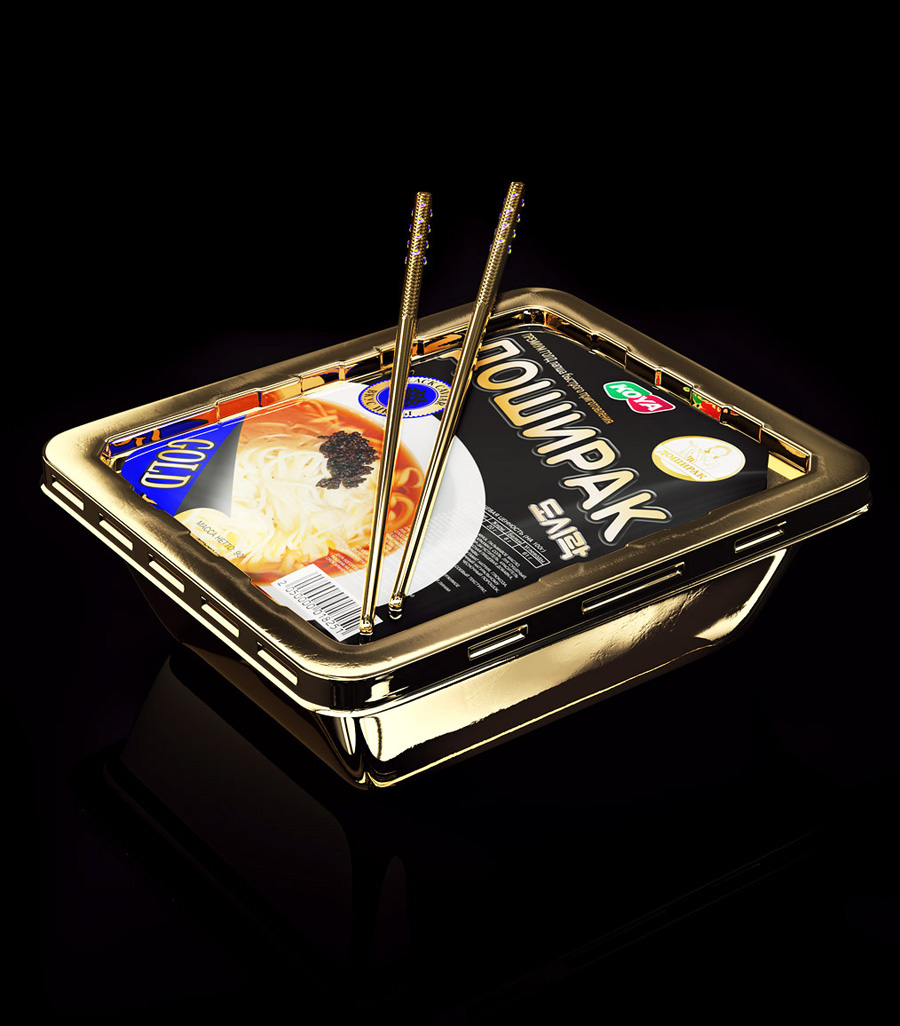
Doshirak is the Korean-based company with an enviable 20-percent market share in Russia. It even now sells instant noodles flavoured with black caviar. Check out the video clip by KBS World Radio here. ( Just click on the orange icon on the right).

sources:
http://world.kbs.co.kr/english/news/news_Cu_detail.htm?No=71810&id=Cu
http://www.russiajournal.com/node/5483
http://www.statemaster.com/encyclopedia/Instant-noodles
http://popsop.ru/wp-content/uploads/doshirak2.jpg
http://popsop.com/5648

Monday, April 12, 2010

Don't Need No Black Day To Eat Jjajangmyeon!


Mark this on your calendar - April 14 is Black Day ( 14th Feb is Valentine's Day when girls in Korea give their boyfriends chocs, etc. 14th of March is White Day in Korea, and Japan when the girls expect the guys to reciprocate generously). So, the marketing people in Korea are smart or kind enough not to leave out those who are without any significant other.


But I don't need any special day or excuse to enjoy jjajangmyeon. Trouble is it isn't so easy to find a great place to enjoy this Korean-Chinese noodle dish made with black bean sauce. I still can't get over how great the dish was when I first ate it in a Chinese restaurant a stone's throw away from Seoul House some years back. It was Chuseok and most places were closed. Mum and I had just spent time walking around the Namsan Hanok Village and were looking for a place to rest and have a meal and fortunately we spotted this place near Seoul House. The dish was so flavourful, generous and satisfying, I still salivate thinking of it. Sadly, still haven't found another place which offers good jjajangmyeon in my neighbourhood. Tried making it but not very successful.

My White Day post had a video so I wondered if there was something on youtube for Black Day. Found this amusing video, so thanks to mongdori for posting this.


source:
http://www.youtube.com/watch?v=Xh6SvbJIh-A&nofeather=True
http://www.forbes.com/2008/04/11/korea-black-singles-day-oped-cx_hra_0411singles.html
http://www.reuters.com/article/idUSSEO18852320080414
http://english.visitseoul.net/visit2007en/lodgingdining/fooddrinks/fooddrinks.jsp?cid=104&sid=1009

Monday, April 5, 2010

The Scent of Spring...NOT !!!!

Here's a sign of globalisation - Koreans, or at least some Seoulites,  have learnt to appreciate durians and the fruits which have long been a favourite in South-East Asian countries are now available in Lotte Mart. Looks like the Thais have beaten the Malaysians in terms of cornering the Korean market. Like kimchi, durians are an acquired taste - the smell can be so offensive to some that they've been banned on train stations but the taste can be addictive.


Caption from the JoongAng Daily: Employees of Lotte Mart’s Seoul Station branch, in central Seoul, yesterday taste durians that are being sold at a 40 to 50 percent discount. Each durian will cost 14,800 won ($13.14). The durians were picked by Lotte Mart six months ago from farms in Thailand. [YONHAP]


source:

Sunday, April 4, 2010

Too Pretty To Eat

This tteok is too pretty to eat. Question is: Are the real cherry blossoms out yet in Yeouido Park in Seoul? Looks like springs and autumns are increasingly shorter and unpredictable in Korea.  Is this a result of global warming or El Nino?


Caption in KBS World Photo News:
Onlookers admire various types of rice cake that were on display at an event promoting the globalization of Korean rice cakes and local consumption of rice at Yeouido Park in Seoul on Tuesday. (Yonhap News)

source:
http://world.kbs.co.kr/english/news/news_photo_detail.htm?No=14669¤t_page=

Thursday, March 11, 2010

The Many-Splendoured Delights of Maehwa and Maesil

The plum blossom is not only pretty to look at but also pretty good for the body in more ways than one.


Koreans use the flowers ( maehwa)  to make apricot flower tea while the dried fruits ( maesil) are used to make Japanese apricot tea. The fruits have high levels of citric acid which help to boost your energy levels.


The Chinese and Koreans have been tapping on the medicinal properties of the maesil for more than 3,000 years. They've found that it's useful for dealing with stomach ailments and digestive problems. It's also been claimed that it can fight sterility, cancer, epilepsy and haliotosis.


Maesil is reputed to have four times the amount of calcium which can be found in an apple. Its iron content is also much higher, besides being rich in magnesium and zinc.  


Maesil-cha is a popular drink especially during summer while Maesil juice is sold as a health tonic.   You can buy the concentrated syrup from supermarkets - just mix a few spoonfuls into water to enjoy a glass of Maesil juice at your own convenience. 

If that's too tame for you, there's also Maesil ju (매실주). Some of the more well-known  names for the plum wine are  Mae Hwa Su, Mae Chui Soon, and Seol Joong Mae.  The whole fruits are also included in the liquor  bottles.  

 Apparently there's also chopped maesil mixed with gochujang (hot pepper sauce). Couldn't find a picture or Korean name for that dish but found on the KNTO website a picture of tteok shaped like maehwa.


sources:
http://discoverkorea.co.kr/bbs/zboard.php?id=gallery&page=2&category=&sn=off&ss=on&sc=on&keyword=&prev_no=&sn1=&divpage=1
http://www.koreatimes.co.kr/www/news/nation/2008/03/115_20399.html
http://www.invil.org/english/speciality/fruit/others/contents.jsp?con_no=841962&page_no=1
http://www.foodinkorea.org/eng_food/korfood/korfood9_2.jsp
http://www.momoy.com/2007/03/15/japanese-apricot-flower-festival/
http://english.visitkorea.or.kr/enu/FU/FU_EN_15.jsp?cid=969529
http://english.visitkorea.or.kr/images/wallpaper/0811/paper0811_01_1024.jpg
http://world.kbs.co.kr/english/culturenlife/culturenlife_tour_detail.htm?No=1351
http://www.visitkorea.or.kr/enu/SI/SI_EN_3_2_1.jsp?cid=292955
http://www.korea.net/News/News/NewsView.asp?serial_no=20090223002
http://www.koreatimes.co.kr/www/news/include/print.asp?newsIdx=41577
http://www.joonsfamily.com/lofiversion/index.php/t20373.html
http://www.youtube.com/watch?v=AtFvdNZ1jwg
http://www.koreatimes.co.kr/www/news/art/2009/10/203_20685.html
http://www.goldeneagletrading.com/korea/korea.html
http://english.bohae.co.kr/main.php?act=MATCHSOON&PG=A07
http://www.koreatimes.co.kr/www/news/biz/2009/10/123_26078.html
http://en.wikipedia.org/wiki/Prun_mume

Saturday, March 6, 2010

Tricoloured Manduguk Evokes Spring Colours


This pretty dish caught my eye recently. It's another example of how creativity can turn an ordinary Korean household into something that delights the eye as well as the palate. Mandu is usually beige but the lucky 800 guests who attended "Korean Night" on Jan. 28, 2010 during the Davos World Economic Forum got a chance to sample tricoloured manduguk ( Samsaek manduguk or three-color dumpling soup).

The dumplings were stuffed with kimchi, tofu and meat and  served as one of the appetizers prepared by the Korean chefs led by Park Hyo-nam, executive chef from the Millennium Seoul Hilton. I'm guessing the chefs used the juice from tomatoes and spinach to transform the pale mandu skins into a beautiful bouquet that evoked the cherry blossoms and pale green shoots of spring.

Wished the JoongAng Daily had featured more of Chef Park's creations. Would've been interesting to see what else he had done to make the Korean dishes aesthetically and appealing, taste-wise to non-Koreans.

source:
http://joongangdaily.joins.com/article/view.asp?aid=2917337

Tuesday, September 15, 2009

Jirye Art Village – Part 4

Don’t think I’ve ever slept in any place so old before. Quick calculation – 342 years to be exact. I’m spending two glorious nights here at the Jirye Art Village. My room was probably a store-room in the old days but now it’s converted into comfortable rooms.


Love the stark simplicity of my tiny room. Floor covered with yellow, oiled hanji; walls plastered with white paper. Zero furniture here. Just a thin “yo” (mattress) folded alongside thick blankets and pillows; some hooks to hang my coat. The only 21st century thing is the light switch. Location’s great as well. Near the dining-room but away from the washrooms. Best of all, a room with two views – of the dam and the hillside. There are actually 14 guestrooms available for tourists. I paid 20,000 won for two nights’ stay and 24,000 won for two breakfasts and two dinners. ( 2005 prices)
A bell summons us to meals in the cosy dining-room. Breakfast is traditional fare - rice with fish, mushrooms and yummy omelettes. Other memorable meals by Mrs Kim  include Andong chicken stew ( dak-jjim) and Song-i mushrooms steeped in gochujang.

Source of photos: KNTO website

Monday, September 7, 2009

On Kalgksu & Catnapping Toddler Gongju – Part 5

A family on the tour bus invite me to join them for lunch and gamsa-he-yo to them for my first Kalguksu i.e. hand-made egg noodles cooked in a light broth with clams, mushrooms and slices of potato & cucumber. It arrives in a large wok heated on a small gas stove at the dining table. I’m amused to see a large & unpretentious pair of scissors on stand-by, in case diners struggle with long strands of noodles. Those who tire of spicy food will find kalguksu a soothing alternative. This nutritious and filling dish can easily qualify as comfort food.

Originally, I wanted to check out the Lonely Planet’s recommendation to sample Gomanaru’s wide variety of tasty food. ( Check out this enterprising provincial restaurant’s website at www.gomanaru. co.kr/food/menu/ ) The guidebook, however, forgot to mention that reservations are necessary or at least highly recommended. The restaurant was full and so I had to look elsewhere. Fortunately the parents of some of the children on the tour bus come to my rescue with their invitation to join them for the kalguksu lunch.

Time and again, I’m floored by such examples of hospitality from the Koreans. Different people on the tour bus offer me snacks, candy and fruit throughout the day and I’m glad that I brought from home my own supply of junk food to return the compliment. One toddler quickly sizes up the situation and after securing a fair share of sweets, is happy to curl up on me for a catnap on the bus. Don’t know if he’s too tired to care that he’s sleeping on a stranger but I’d like to think that he’s comfortable enough with me not to see as one.