Showing posts with label food. Show all posts

Friday, July 16, 2010

Will The Real Patbingsu Please Stand Up?

It's so confusing - google this summertime treat and one finds a wide array of patbingsu in various shapes, concoctions and colours ( some can rival the psychedelic hues of a 1970s go-go garment). Patbingsu seems to grow more complex with each summer so it got me wondering about the traditional, authentic version which the halmeonis still regard with fondness.

An interesting article in the Korean Times  reminds me that:
"...modern refrigeration was still a rarity (in Korea) until as late as the 1960s...Blocks of ice from the frozen Han River would be stored in piles of sawdust until the hot summer months arrived. Ice was even once managed by official government offices....Tubs filled with salt water ( were used)  to keep the ice ( treats) from melting and street cart vendors would shave the blocks by hand and sell their goods to neighborhood children directly from the stand."


Ingredients like red beans were considered luxuries in the past so the original recipes were regarded as real treats generations earlier. In the poor old days, young Korean children could only look forward to shaved ice topped with red beans, rice cakes and ground nut powders. These days, though, they would look like poor country cousins next to the fancilful Haagen-Daaz or Lotte mart versions.


Some of the toppings now include: fresh or/ and  canned fruits, ice-cream, sweet corn, chocolate chips, cereal flakes, chewy jelly bits, yoghurt, condensed milk, green tea powder and so on.  I've even seen one webpage mention red wine! Wonder when the Koreans will globalise this seasonal dleight or be influenced  by other cultures and start putting durian puree on their patbingsu.


One writer from the JoongAng Daily claims to have "sampled the most authentic patbingsu" at Wallpaper, a Pan-European cafe in Samcheong-dong, northern Seoul. So what makes one patbingsu "more authentic" than another? Obviously, much ado is made of the freshness and texture of the main ingredients.

The reporter points out, "Often bakeries and dessert shops make the culinary faux-pas of using special rice cakes for patbingsu that come in frozen packets. Here, the rice cake is fresh and moist as if it had just come out of a steamer. But most importantly, the ice is ground to perfection. The particles are smooth with a slight milky flavor, and the bowl gets emptied so quickly, the ice hasn’t even melted."


Perhaps the most sublime version of patbingsu can be found or made several thousand kilometres outside Korea. Much to my surprise, the Korean researchers at the King Sejong Station, a research base in the Antarctic still have a liking for this cold dessert despite living daily with sub-zero temperatures. The chef attached to the base uses icebergs for the shavings. But if you prefer some real down-to-earth patbingsu, take the cue from some researchers who like to spread the red beans on the pristine snow and eat the mixture with their hands.

Chef Lee Sang-hoon with his "refrigerator"  in the background.
sources:
http://joongangdaily.joins.com/article/view.asp?aid=2893988
http://joongangdaily.joins.com/article/view.asp?aid=2890518
http://en.wikipedia.org/wiki/File:600patbingsoo.2jpg.jpg
http://www.servinghistory.com/topics/patbingsu
http://www.koreatimes.co.kr/www/news/art/2010/05/203_66980.html
http://id.wikipedia.org/wiki/Berkas:Korean_shaved_ice-Patbingsu-Nokcha_bingsu-Cherry_tomatoes.jpg
http://www.seriouseats.com/recipes/2009/08/how-to-make-patbingsu-korean-shaved-ice-recipe.html

Monday, May 3, 2010

Have Squid, Will Gut

One of the stops made on a day tour I joined in Jeju was a seafood eatery of sorts. The dining area was tucked within some tents and I wasn't feeling too adventurous, having had a bad encounter with seafood the day before. So I was content to let the Korean tourists enjoy my share of the raw seafood while I watched the ajummas at work.

It was a great opportunity to have a free lesson in how to cut and clean squid. Spent at least a quarter of an hour watching them wield their knives so deftly. Too bad I don't ever cook squid in my own kitchen.

The following videos posted by others were taken in other parts of Korea but I think the technique is the same.


Thanks to ffej4321 for posting this on YouTube.


Thanks to lisaruck10 for this one!

sources:
http://www.youtube.com/watch?v=xVCkXzHW364&feature=related
http://www.youtube.com/watch?v=36L_2Gi-sdI&feature=related

Friday, April 23, 2010

Guess What The Russians Are Eating?

Thought that Asians were the only ones who eat instant noodles but have just learnt that it has become “Russia’s second bread”. ( This came from an article in 2001). Hard times and convenience have contributed to its increasing popularity in Russia over the past decade.

Many pooh-pooh its lack of nutritional value, and regard it as the poor man’s food, giving it a derogatory label, Bomi-paket, Russian slang which literally translates into “a tramp’s bundle”. However, many office workers, hikers find it a handy meal. Apparently, 20 packets of noodles is equivalent to one Big Mac in Russia.

Vladimir Kitov, whose article appeared in The Russia Journal, cited these other statistics:

“According to data from the GfK MR market-survey agency, sales of the noodle packages, which cost from 2 to 18 rubles, remained the fastest-growing segment of the Russian food market last year, totaling 1.7 billion rubles ($60 million). Overall sales of tomato ketchup, by contrast, came to just 40.1 million rubles ($1.3 million) for the same period.”


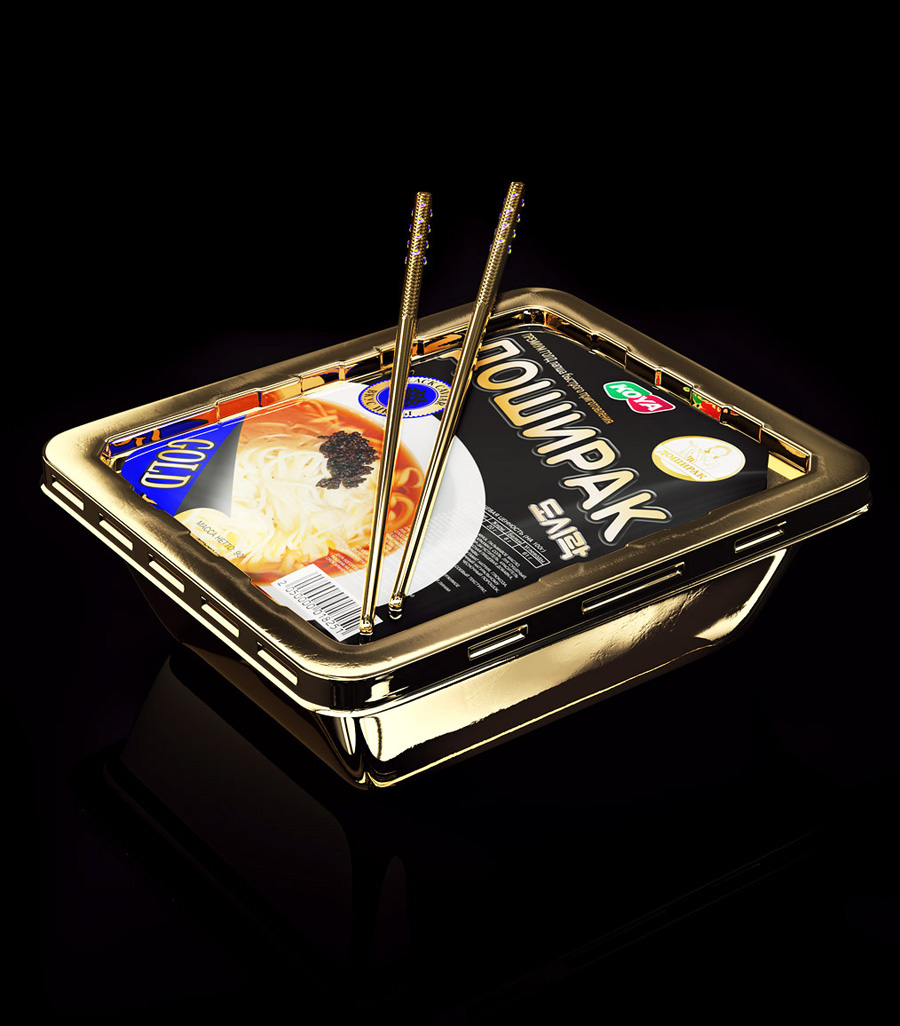
Doshirak is the Korean-based company with an enviable 20-percent market share in Russia. It even now sells instant noodles flavoured with black caviar. Check out the video clip by KBS World Radio here. ( Just click on the orange icon on the right).

sources:
http://world.kbs.co.kr/english/news/news_Cu_detail.htm?No=71810&id=Cu
http://www.russiajournal.com/node/5483
http://www.statemaster.com/encyclopedia/Instant-noodles
http://popsop.ru/wp-content/uploads/doshirak2.jpg
http://popsop.com/5648

Monday, April 12, 2010

Don't Need No Black Day To Eat Jjajangmyeon!


Mark this on your calendar - April 14 is Black Day ( 14th Feb is Valentine's Day when girls in Korea give their boyfriends chocs, etc. 14th of March is White Day in Korea, and Japan when the girls expect the guys to reciprocate generously). So, the marketing people in Korea are smart or kind enough not to leave out those who are without any significant other.


But I don't need any special day or excuse to enjoy jjajangmyeon. Trouble is it isn't so easy to find a great place to enjoy this Korean-Chinese noodle dish made with black bean sauce. I still can't get over how great the dish was when I first ate it in a Chinese restaurant a stone's throw away from Seoul House some years back. It was Chuseok and most places were closed. Mum and I had just spent time walking around the Namsan Hanok Village and were looking for a place to rest and have a meal and fortunately we spotted this place near Seoul House. The dish was so flavourful, generous and satisfying, I still salivate thinking of it. Sadly, still haven't found another place which offers good jjajangmyeon in my neighbourhood. Tried making it but not very successful.

My White Day post had a video so I wondered if there was something on youtube for Black Day. Found this amusing video, so thanks to mongdori for posting this.


source:
http://www.youtube.com/watch?v=Xh6SvbJIh-A&nofeather=True
http://www.forbes.com/2008/04/11/korea-black-singles-day-oped-cx_hra_0411singles.html
http://www.reuters.com/article/idUSSEO18852320080414
http://english.visitseoul.net/visit2007en/lodgingdining/fooddrinks/fooddrinks.jsp?cid=104&sid=1009

Monday, April 5, 2010

The Scent of Spring...NOT !!!!

Here's a sign of globalisation - Koreans, or at least some Seoulites,  have learnt to appreciate durians and the fruits which have long been a favourite in South-East Asian countries are now available in Lotte Mart. Looks like the Thais have beaten the Malaysians in terms of cornering the Korean market. Like kimchi, durians are an acquired taste - the smell can be so offensive to some that they've been banned on train stations but the taste can be addictive.


Caption from the JoongAng Daily: Employees of Lotte Mart’s Seoul Station branch, in central Seoul, yesterday taste durians that are being sold at a 40 to 50 percent discount. Each durian will cost 14,800 won ($13.14). The durians were picked by Lotte Mart six months ago from farms in Thailand. [YONHAP]


source:

Sunday, April 4, 2010

Too Pretty To Eat

This tteok is too pretty to eat. Question is: Are the real cherry blossoms out yet in Yeouido Park in Seoul? Looks like springs and autumns are increasingly shorter and unpredictable in Korea.  Is this a result of global warming or El Nino?


Caption in KBS World Photo News:
Onlookers admire various types of rice cake that were on display at an event promoting the globalization of Korean rice cakes and local consumption of rice at Yeouido Park in Seoul on Tuesday. (Yonhap News)

source:
http://world.kbs.co.kr/english/news/news_photo_detail.htm?No=14669¤t_page=

Thursday, March 11, 2010

The Many-Splendoured Delights of Maehwa and Maesil

The plum blossom is not only pretty to look at but also pretty good for the body in more ways than one.


Koreans use the flowers ( maehwa)  to make apricot flower tea while the dried fruits ( maesil) are used to make Japanese apricot tea. The fruits have high levels of citric acid which help to boost your energy levels.


The Chinese and Koreans have been tapping on the medicinal properties of the maesil for more than 3,000 years. They've found that it's useful for dealing with stomach ailments and digestive problems. It's also been claimed that it can fight sterility, cancer, epilepsy and haliotosis.


Maesil is reputed to have four times the amount of calcium which can be found in an apple. Its iron content is also much higher, besides being rich in magnesium and zinc.  


Maesil-cha is a popular drink especially during summer while Maesil juice is sold as a health tonic.   You can buy the concentrated syrup from supermarkets - just mix a few spoonfuls into water to enjoy a glass of Maesil juice at your own convenience. 

If that's too tame for you, there's also Maesil ju (매실주). Some of the more well-known  names for the plum wine are  Mae Hwa Su, Mae Chui Soon, and Seol Joong Mae.  The whole fruits are also included in the liquor  bottles.  

 Apparently there's also chopped maesil mixed with gochujang (hot pepper sauce). Couldn't find a picture or Korean name for that dish but found on the KNTO website a picture of tteok shaped like maehwa.


sources:
http://discoverkorea.co.kr/bbs/zboard.php?id=gallery&page=2&category=&sn=off&ss=on&sc=on&keyword=&prev_no=&sn1=&divpage=1
http://www.koreatimes.co.kr/www/news/nation/2008/03/115_20399.html
http://www.invil.org/english/speciality/fruit/others/contents.jsp?con_no=841962&page_no=1
http://www.foodinkorea.org/eng_food/korfood/korfood9_2.jsp
http://www.momoy.com/2007/03/15/japanese-apricot-flower-festival/
http://english.visitkorea.or.kr/enu/FU/FU_EN_15.jsp?cid=969529
http://english.visitkorea.or.kr/images/wallpaper/0811/paper0811_01_1024.jpg
http://world.kbs.co.kr/english/culturenlife/culturenlife_tour_detail.htm?No=1351
http://www.visitkorea.or.kr/enu/SI/SI_EN_3_2_1.jsp?cid=292955
http://www.korea.net/News/News/NewsView.asp?serial_no=20090223002
http://www.koreatimes.co.kr/www/news/include/print.asp?newsIdx=41577
http://www.joonsfamily.com/lofiversion/index.php/t20373.html
http://www.youtube.com/watch?v=AtFvdNZ1jwg
http://www.koreatimes.co.kr/www/news/art/2009/10/203_20685.html
http://www.goldeneagletrading.com/korea/korea.html
http://english.bohae.co.kr/main.php?act=MATCHSOON&PG=A07
http://www.koreatimes.co.kr/www/news/biz/2009/10/123_26078.html
http://en.wikipedia.org/wiki/Prun_mume

Saturday, March 6, 2010

Tricoloured Manduguk Evokes Spring Colours


This pretty dish caught my eye recently. It's another example of how creativity can turn an ordinary Korean household into something that delights the eye as well as the palate. Mandu is usually beige but the lucky 800 guests who attended "Korean Night" on Jan. 28, 2010 during the Davos World Economic Forum got a chance to sample tricoloured manduguk ( Samsaek manduguk or three-color dumpling soup).

The dumplings were stuffed with kimchi, tofu and meat and  served as one of the appetizers prepared by the Korean chefs led by Park Hyo-nam, executive chef from the Millennium Seoul Hilton. I'm guessing the chefs used the juice from tomatoes and spinach to transform the pale mandu skins into a beautiful bouquet that evoked the cherry blossoms and pale green shoots of spring.

Wished the JoongAng Daily had featured more of Chef Park's creations. Would've been interesting to see what else he had done to make the Korean dishes aesthetically and appealing, taste-wise to non-Koreans.

source:
http://joongangdaily.joins.com/article/view.asp?aid=2917337

Sunday, February 21, 2010

Where's The Pollack?

Two clichés in K drama: First, a fierce ajumma hits a young upstart with the wooden sticks used to beat or flatten the laundry OR second, she uses a stick-like object which turns out to be pollack, a wind-dried fish popular in Korea. Unfortunately, over-fishing and over-eating of even the young pollack may have driven this fish to the edge of extinction so ajummas inclined to whack the living daylights out of someone may be hard-pressed to look for a handy pollack. ( The info for the graph created below was taken from the JoongAng Daily. )


Alarmed by this trend, the East Sea Fisheries Institute of the National Fisheries Research and Development Center has offered ten times the market rate for anyone who brings in a live pollack so that the experts there can retrieve the eggs for a rehabilitation program. Turns out it isn’t so easy to breed pollack in captivity. So the alternative has been to collect eggs from freshly –caught pollack.


Hopefully they’ll find a way of reversing the trend in the declining pollack population so that future generations of Koreans and tourists can enjoy pollack soup and fiery ajummas won’t lack dried-up pollacks whenever they feel like whacking someone.

"This fish is called myeongtae when they are alive in the sea, but they are called saengtae when they are caught. They are named dongtae when frozen and when they are hung and dried here, they are finally called hwangtae. Since they are string-skewered through their noses, they are called hwangtae kodari." ( quote from KBS World Radio article, "Discover Inje's Treasure In the Winter Season")

For KBS World Radio feature article on pollack, click here.
http://joongangdaily.joins.com/article/view.asp?aid=2916198

Thursday, February 11, 2010

What Tteok-guk Used To Mean

It may be everyday  comfort food for Koreans living abroad  but tteok-guk used to be a big deal when celebrating Seollal. ( It still is? ) Tteok-guk was served to celebrate everyone's collective birthday party. No blowing out of candles on a calorie-laden cream cake but downing of thin slices of rice-cakes swimming in bowls of hot steaming beef broth topped with green onions, egg slices and seaweed. Kids who fancied claiming equality with their older siblings were often conned into wolfing more bowls by teasing relatives.


It's easy to forget that rice wasn't always the staple food at the Korean dinner table. One can easily find packets of pre-sliced garaetteok in any supermarket in Korean these days but in the past, Koreans had to make do with barley, millet or noodles made from buckwheat, arrowroot or sweet potatoes for their daily starch or carbo fix. Bear in mind as well that rice was particularly hard to come by in winter.

Haven't found a website that shows how garaetteok is actually made from the rice flour  ( the rough recipe goes something like this: grind the rice into flour - steam it - roll it out into long sausage-like shapes) but I read somewhere that  it used to take  three days to make. While the shape of garaetteok signifies good health and long life, the white colour denotes purity and cleanliness. It's then cut up into shapes resembling coins to express the wish for prosperity and wealth in the year ahead.


Beef was another rare commodity ( these days, it's just expensive and fraught with political and nationalist overtones - does one buy local beef or imports from the US or Australia? ) so the beef stock for the dish was a really special treat for Koreans of the past. In even earlier times, the soup was made from the stock of pheasant meat or chicken.


Now it's time to 'fess up. I haven't eaten tteok-guk before so I'm going to scout around the Korean restaurants near my home this Seollal period  to see if I can sample the stuff. If that doesn't work out, well I'll just have to google for a recipe and get cracking in the kitchen. All this googling for pics has whetted my appetite and roused my curiosity!

sources:
http://www.koreatimes.co.kr/www/news/art/2010/01/153_38384.html
http://yunhee66.wordpress.com/2009/10/10/kalap-di-korean-mart/
http://joonsfamily.com/lofiversion/index.php/t8572-100.html
http://simple.wikipedia.org/wiki/Tteokguk
http://oneforkonespoon.wordpress.com/2009/04/13/tteok-guk-comfort-food-for-kings/
http://www.asianewsnet.net/news.php?id=3621&sec=9

Wednesday, December 16, 2009

Everyone's A Year Older This Dec 22!


The Winter Solstice (which falls on 22 December in 2009) and  known as Dongji in Korea (Dongzhi in China) , is observed as the longest night and shortest day of the year. It’s also viewed as “the day that ushers in the new year”. Roots of this festival go back a long way to the Chinese beliefs in the balance of yin and yang. The ancients believed that this night marked the beginning of the end of winter and also an increase in positive energy with more daylight hours. As it is a time for hope and recovery, some Chinese families even regard Dongzhi as even more important than their Lunar New Year festival and mark the occasion with reunion dinners.


Patjuk is a staple of Dongji in Korea. This recipe calls for glutinous rice flour to be rolled into small balls and added to a sweetened red-bean gruel. While the white rice balls symbolise new life, the red bean porridge stood for kicking evil spirits out of one’s home.


According to old wives’ tales, evil spirits hate red. The colour is also associated with ‘yang’ ( meaning positive energy) so Korean ajummas used to spray red beans cooked into patjuk all over their homes to discourage such spirits from entering. They also said that a warm winter solstice was a bad omen of disease and death while a cold and snowy solstice signalled prosperity in the coming year.


Patjuk was also offered as part of the first harvest of the season at the ancestral table. Modern housewives are more likely to give their children patjuk because red beans are reputed to be especially good for keeping the body warm and hydrated. Of all the grains, they’re the ones with the most vitamin B1.


Koreans also believed that a person was one year older after eating a bowl of patjuk with one rice ball for each year of his or her age. Question is: How on earth do the halmoenis avoid indigestion if they have to consume so many glutinous rice balls?

sources:
http://world.kbs.co.kr/english/news/news_photo_detail.htm?No=3770¤t_page=101

Wednesday, November 11, 2009

Pepero Day VS Garaetteok Day - Among Some Trivia Just Dug Up


Did you know...?
  1. Pepero didn't originate from Korea. It's been sold in the Japanese market as Pocky since 1965?
  2. In some elementary school,s classmates exchange Pepero gifts at 11: 11 am on Nov 11? ( the figures lined up look like the chocolate covered snacks lined up)
  3. The celebration started off in 1994 in a middle school for girls in Busan.
  4. Female classmates traded them to express their fond wish to be as slender as Pepero. ( This is version 1 of its origins)
  5. It may be a brainwave of the Lotte marketing department ( Version 2 of origins)
  6. Some schools have made it official policy to ban the exchange of such gifts on Nov 11 as they deem it a distraction.
  7. Even adult Koreans celebrate Pepero Day - it's a relatively cheap way to earn brownie points with your colleagues, employees or employers.
  8. It's serious business - Sales one year amounted to 44 billion won! Since 2000, sales have experienced double-digit growth.
  9. Lotte has even dedicated a website to PD with a new theme song each year.
  10. Merchandise related to PD just keep getting bigger and more varied - earrings, film screenings, notebooks etc.
  11. In a bid to beef up rice consumption, the National Agricultural Cooperative Federation ( a.k.a Nonghyup) are trying to promote Nov 11 instead as "Garaetteok Day" ( Rice-cake Day).


      Hmm...something tells me GD isn't going to take off.


Haven't had enough? Click here for for flash animation promoting Pepero Day

Sources:
http://www.pepero.co.kr/img/flash/ani/ani03.swf
http://www.post-gazette.com/pg/06314/737326-82.stm
http://joongangdaily.joins.com/article/view.asp?aid=2489311
http://joongangdaily.joins.com/article/view.asp?aid=2912393
http://www.johyunjae.hk/blog/rewrite.php/read-4694.html

Thursday, October 1, 2009

Songpyeon on My Pillow

Don’t be surprised to find songpyeon instead of complimentary chocolates on the pillow if you’re staying in a Korean hotel this weekend. After all, it’s Chuseok and what better way for Korean hotels to involve their foreign guests in the harvest celebrations?


I was touched by this thoughtful gesture, courtesy of Core Riveria Hotel, when I was in Jeonju a few years ago. The pretty rice cakes were sitting on a thin bed of pine leaves in a basket. Can’t recall what the filling was – was it chestnut or were red, green or mung beans used? Anyway, the charming picture the songpyeon presented gave me even more pleasure than the taste itself.


Unlike the Chinese who observe the Mid-Autumn Festival with cakes that resemble the full moon, Koreans like their songpyeon shaped like half moons. A full moon can only mean it’s waning while the half moon promises fullness and greater brightness to come. Honestly though, the songpyeon look more like tiny conch shells than half moons to me. Apparently, shapes and sizes vary from region to region – those in the south make smaller cakes while the Gangwon-do variety resemble clams.

Lee Ho -jeong writes:


Donggukseshigi, a Joseon Dynasty publication from 1849 that documented the seasonal customs of the period, states that songpyeon "uses the rice grain taken from rice straw that has been kept since the fifteenth day of the first month of the year. Some as large as the size of a hand or as small as an egg, the songpyeon are made in the shape of a half circle of jade" .The Donggukseshigi also says that songpyeon was dispensed to servants according to their age.The gifts of songpyeon were designed to increase the servant’s morale as the harvest began.

There are stories that have passed from generation to generation about the making of songpyeon.
For the unmarried, they can find a beautiful wife or a handsome husband when the songpyeon they make has a beautiful shape. An unattractive or mishapen songpyeon will result in a life spent with an ugly husband or wife. Another legend says that a pregnant woman who hoped to learn the gender of her unborn child should steam the songpyeon while placing a pine leaf or pine needle in a horizontal position within the songpyeon. If the sharp end of the needle or the pine leaf appears when the woman takes a bite from the songpyeon the child within her is a boy. If the smooth flat area appears the unborn child is a girl. "


Those who are really into making desserts and traditional cakes, check out the Rice Cake and Kitchen Utensils Museum (open Mon –Sat, 10 am – 5 pm; tel: 02 – 741 5411/4). There’s a cafĂ© nearby selling a wide range of such delicacies as well. Or if you happen to be in Insadong, ask around for the rice cake stores in Nagwon-dong, Jongno-gu.

For more information and a recipe, click here.


The photo above shows Hyundae employees making songpyeon for the elderly  in a home as part of their community service. It would be interesting to know if many Korean families still follow the tradition of making songpyeon together or if they prefer to buy them ready-made at the convenience store.

For more on tteok ( rice cakes ) in general, read this.

Sources:
http://english.seoul.go.kr/gtk/news/reports_view.php?idx=1071&cPage=45 http://www.korea.net/News/news/NewsView.asp?serial_no=20061004038&part=111&SearchDaykorea.encyclopedia.co
http://www.sulyapinoy.org/feature-stories-f12/what-is-the-meaning-of-chuseok-http://www.koreatimes.co.kr/www/news/include/print.asp?newsIdx=10234
http://www.korea.net/News/News/NewsView.asp?serial_no=20080609001&part=106&SearchDay=
http://www.joonsfamily.com/lofiversion/index.php/t8572-200.html