Friday, April 6, 2012

It's Snowing Cherry Blossoms in Jinhae....Not...Yet?

Is Nature playing an April Fool's trick on people hoping to see the cherry blossoms out in full force at the naval base of Jinhae? According to a report from the Chosun Ilbo, the KMO's predictions about the appearance of the cherry blossom is off by a week or so, no thanks to a cold snap. Pity, considering the town is celebrating its 50th anniversary of the cherry blossom festival this year. Anyone who's in Jinhae,or been there recently, please correct me if I'm wrong and tell me if  the place is chockful of cherry blossoms right now.


Regions 2012 Blooming Dates ( from the KTO webpage) but read ahead for the latest amendments for the cherry blossoms' ETA.
Seogwipo 3.24 /  Busan 3.30  / Yeosu 4.4  / Tongyeong 4.1  / Gwangju 4.3 / Jeonju 4.7  / Daegu 3.31 / Pohang 4.2 / Daejeon 4.4 / Cheongju 4.7 / Seoul 4.10 / Incheon 4.13 / Gangneung 4.8 / Chuncheon 4.11
Jinhae Yeojwacheon Stream 3.29 / Hadong Ssanggyesa Temple Simni Cherry Blossom Path 4.1 / Jeonju-Gunsan Beonyeong-ro 4.8 / Cheongju musimcheonbyeon 4.2 / Seoul Yeoui-do Yunjung-ro 4.9

from the Chousn Ilbo:
Cold Snap Delays Cherry Blossom

The last cold spell in April has delayed the arrival of Korea's famous seasonal cherry blossom. The Korea Meteorological Administration on Thursday revised its prediction that the cherries would blossom in early April in most of the southern region. Blossoming will be delayed by three to six days in the south and by one or two days in central Korea, it added. The KMA officially declares the arrival of the cherry blossom when at least three blossoms appear in a tree in weather observatories nationwide. A KMA official said, "Normally, cherry blossoms bloom fully about one week after the first blossom is observed. Cherry blossom season will peak before mid-April in the southern region, and after mid-April in the central region."

sources:
http://english.chosun.com/site/data/html_dir/2012/04/06/2012040601181.html
http://www.12fly.com.my/2012/03/korea-cherry-blossom-forecast-2012/
http://english.visitkorea.or.kr/enu/FU/FU_EN_15.jsp?nCategoryID=1&SearchType=&keyword=&gotoPage=4&cid=1566923&cCode=&nCategoryID=1&searchType=&searchKeyword=

Wednesday, February 29, 2012

Daeboruem's Fire And Moon Viewing Rituals - Ajumma's Itinerary For Night Owls - Part 1

I'm no night owl but I thought it would be fun to see if I could come up with a bucket list of places to visit  in Korea  specially for night owls. While the country is known as Land of the Morning Calm, it's also, I like to believe, a beautiful place at night. So this first posting in a series which I'm calling "Ajumma's Itinerary For Night Owls"  is dedicated to the Daeboreum Festival (Great Full Moon Day to welcome the first full moon of the lunar year).


I know this is somewhat belated as the Daeboreum festival was celebrated in different parts of the country such as in Jeju and Samcheok in Gangwon-do  just a few weeks ago ( at the end of the Spring Festival for the Chinese) but those interested enough can start planning for 2013. You may also want to check out postings on this subject by two bloggers, Sherwin Jones and the author of tigersandmagpies. They have interesting accounts of their first-hand experiences of this festival which originated from China but also developed its own local character and mythology when it spread to the Korean peninsular.

Imagine a

Here's a checklist of what I would do to participate a little more fully in the festival:
  • The night before Daeboreum, I'd take part in  gwibulnori (쥐불놀이). This game started off as an agrarian practice when cow herders "burned the dry grass on ridges between rice fields while children whirled around cans full of holes, through which charcoal fire blazed." The latter was supposed to rid the fields of undesirable insects or worms and the burning of the grass was believed to promote the growth of healthier grass fodder for the cattle. Must make the effort to get the traditional crude can instead of a battery-powered device for the full romantic effect. Click here to see what I mean.

  • Burn daljip (a tradition of burning a bundle of twigs to bring good luck). Note to self- Remember to get gloves!

  • Practise dalmaji i.e. find a novice-friendly mountain to climb with friends and family to catch the first glimpse of the full moon. The idea is the first person to see the moon rise will have good luck all year or a wish will be granted but hey, I'm not planning to race to the top. If the moon will oblige by turning up and not tease me by hiding behind any cloud, I'll count myself lucky.
Aside from these fire and moon-viewing rituals, you may want to look for these festive goodies to savour:

  • I'll get the oligatory chestnuts, walnuts etc but I'll draw the line at trying to crack them with my own teeth. The old wives' tale is that by doing this , you won't need dental services for the rest of the year but I have my doubts. Mental note no 2 to self: Carry a nutcracker.

  • Eat  Ogokbap (오곡밥 / 五穀밥) for breakfast on Daeboreum. This is a five-"grain" rice consisting of rice, millet, Indian millet, beans, and red beans. No problem - question is: Can I have it with my kimchi tchigae?   Two other dishes which are on the eat-list would be namul and  Yaksik (약식 / 藥食), which is made of glutinous rice, chestnuts, pinenuts, honey, sauce, and sesame oil.

  • Drink cheongju , a clear rice wine which is supposed to clear the ears to hear good news for the rest of the year. Hmmm....if it's anything like soju, I'll pass. I'd rather drink a toast to the moon with bokbunja.

    If jostling with the crowds in open fields and risking getting too close to burning embers doesn't appeal to you, there's another way one can observe Daeboreum in a more sedate manner.

Woljeongsa Temple had a 2 day, 1 night templestay program specially designed for the occasion ( 17 and 18 February). It included :
  •  meditation in the moonlight - that almost sounds romantic.
  • making a wish list and circling a pagoda in the hope that your wish will be fulfilled, and
  • Dari Bapggi (Treading the Bridge ritual to stave off bad luck for the year)
sources:
http://english.visitkorea.or.kr/enu/SI/SI_EN_3_2_1.jsp?cid=697232
http://buriburi.go.kr/foreign/eng/htmls/main.htm
http://en.wikipedia.org/wiki/Daeboreum
http://www.sherwinvjones.com/gyeongjublog/2012/02/photos-dangsan-tree-on-daeboreum/
http://eng.templestay.com/board/board.asp?bt=2&idx=132&cid=13
http://english.visitkorea.or.kr/enu/FU/FU_EN_15.jsp?cid=1249628
http://english.visitkorea.or.kr/enu/SI/SI_EN_3_6.jsp?cid=255585
http://tigersandmagpies.com/2012/02/jeju-jeongwol-daeboreum-fire-festival-2012/
http://www.chinesefortunecalendar.com/LanternFestival.htm
http://www.globaltimes.cn/NEWS/tabid/99/ID/694421/Lantern-Festival-2012-in-China.aspx
http://books.google.com.my/books?id=VSIsb4qmoQcC&pg=PA89&lpg=PA89&dq=origins+of+daeboreum&source=bl&ots=Ra43itWI7O&sig=gJLWJESBKIFCjekoJT-vZl0JauM&hl=en&sa=X&ei=4PBNT-7aEcLRrQeV7uyKDw&ved=0CDUQ6AEwAw#v=onepage&q=origins%20of%20daeboreum&f=false
http://en.wikipedia.org/wiki/Night_owl_(person)
http://www.koreatimes.co.kr/www/news/art/2011/03/203_39010.html

Sunday, February 19, 2012

The Travails Of Trying To Eat Like Korean Buddhist Monks

What is the most challenging part of trying to eat like a Buddhist monk?

a. Do nothing but eat
b. Eat in silence
c. Eat V- - E - - R - -Y ......................S- L – O – W – L - Y
d. Eat everything in your bowl
e. Drink the water used to clean the bowls
f. All of the above.


Personally I’d have serious problems with the first one. I’ve to break a lifetime habit of multitasking at mealtimes – I’d be catching up on news and rushing through breakfast simultaneously, gulping down lunch while Googling on the office desktop and socializing time, either with family, friends or the idiot box, takes place over dinner. I honestly can’t remember the last time, if ever, when I simply sat down and ate without the company of a book, magazine, radio, TV, mobile phone or human being. The notion of simply eating without talking, reading, listening to music or surfing seems like some alien norm from a galaxy far, far away.

So why on earth would I want to eat like a Korean Buddhist monk?

First of all, it’s green – with the emphasis on organic ingredients and no wasting of food to the extent that you’re expected to take only what you can consume and you’re even supposed to drink the water used to clean the bowl and slurp down each tiny morsel remaining in the bowl.


Next, it’s healthy –temple meals are wholesome, high in protein and low in calories. There’s no meat and no alcohol. Instead of using highly processed ingredients such as white rice and chemical additives like MSG, vegetarian dishes are prepared with natural condiments such as shitake powder and kelp powder. Fermented ingredients which can lower cholesterol and inhibit cancer are widely used in temple recipes. Modest portions are also encouraged instead of super-sized meals.

Third, I can feel virtuous meditating while chewing my cud. A typical pre-meal chant goes like this:

“Where has this food come from? My virtues are so little that I am hardly worthy to receive it. I will take it as medicine to get rid of greed in my mind and to maintain my physical being in order to achieve enlightenment.”

The dining experience is to the sunims, a sacred ritual and an opportunity to appreciate and reflect on the interconnectedness of life. While I won’t go so far as to meditate on the virtues of the farmers and the middlemen who played their part in bringing the tchigae to the table, it’s better than mindlessly stuffing my mouth while being distracted by various things that have nothing to do with the meal. I don’t expect every mealtime to be the “very moving experience” described by environmentalist and chimp expert Jane Goodall who took part in the food ceremony during her visit to Korea in 2006 but hopefully like her, I’ll be able to appreciate the value of the food while “chewing the food slowly and thinking about where it had come from”.

But honestly, the main appeal is that I can bid annyeong to the kilos more effectively if I were to adopt the slow-eating habits of the sunims. Slow food, Korean-Buddhist style is not simply the slow-food as envisioned by Carlo Petrini, the founder of the original “slow food movement” in the mid-80s as a reaction against the MacDonald-isation of global food. Instead, it means adjusting one’s pace of eating to the others around you –not too fast and not too slow - all in the name of moderation and harmony.

Am clueless as to how long the usual balwoogongyang temple meal is but I’d like to imagine that mealtime is an unhurried affair without being languid. And that’s what I think will be the most difficult aspect to emulate though clearly there are good reasons for not rushing through meals. One scientific study suggests that if you take a longer time, like half an hour, to chew on your food ( or chew each small bite “15 to 20 times”) and take many pauses between bites to complete a meal, you’re more likely to feel fuller and actually consume fewer calories.

But in a 24/7 world with pressing deadlines, where restaurants and cafes try to outdo each other by the number of TV screens lit up in their dining areas and by their wi-fi accessibility, how does one stop multi-tasking and just literally watch what one eats?


sources:
http://issuu.com/hikekorea/docs/kfs_booklet_final_standard_size
http://www.buddhistchannel.tv/index.php?id=7,3489,0,0,1,0
http://www.nytimes.com/slideshow/2012/02/08/dining/20120208-MINDFUL.html?ref=buddhism
http://koreantemplecuisine.net/blog/?paged=2
http://www.buddhistchannel.tv/index.php?id=7,1469,0,0,1,0
http://en.wikipedia.org/wiki/Korean_temple_cuisine
http://eng.templestay.com/board/board.asp?bt=9&idx=129&cid=21
http://jentrinque.wordpress.com/2010/08/04/
http://mingkok.buddhistdoor.com/resources/get/c8128cf9ec4137dba476c10334da59541d365c65/241/0

Tuesday, January 31, 2012

Peony Power


Never had the chance to meet a Moran in person.  Am clueless about her scent, despite her inclusion in the L’Occitane range.  Yet, I admit, I’ve been prejudiced against her size and rather ostentatious appearance.  That bias has been reinforced since I saw Dong Yi, the historical drama which featured  Lady Jang Hui-bin (?-1701) , one of "the best known royal concubines of the Joseon Dynasty", according to Wikipedia.  She was an ambitious woman who supposedly  plotted against the queen and succeeded in getting the latter deposed.  In one scene from the popular sageuk,  Lady Jang gives orders to replace the modest bleeding heart flowers in the exiled queen's garden with the more showy peony with their profusion of petals.

So I never really bothered in the past to find out more about this flower known as Moran in Korea or the tree peony to garden enthusiasts. It seemed to be such a cliche in Chinese paintings and folding screens.
But a private joke has got me trawling the Net to learn a bit more about this "King of Flowers" as nicknamed by the Chinese. It represents quite a list of attributes - affluence , honour, high status, luck,  happiness, elegance and poise.


Here is a snippet from primaltrek:

"One legend describes how Wu Zetian, the only Empress (690 -705 AD) of the Tang Dynasty, was drinking one day during the winter in the Imperial Flower Garden. While admiring the snow, she was also captivated by the fragrance of the winter flowers that were in bloom. She wrote a poem and sent it to the god in charge of flowers. The poem said that she would visit the garden again the next day and that all the flowers were to bloom and not wait until spring. The next morning hundreds of flowers were in bloom. But, the peony stubbornly disobeyed the order and refused to bloom. The Empress was enraged and gave orders that all the peonies in the capital city of Chang'an were to be banished. Those tree peonies that refused were burned to the ground. From that time on, the peony gained a reputation for resistance and rebellion. As time passed, however, the peony's reputation softened and gradually changed to one symbolizing longevity, loyalty, happiness and eternal beauty."

A pity. If the flower retained its original symbolism, I think I would like it more. The notion of a flower refusing to kow-tow to royalty seems much more appealing.


It also stood for national peace and security during the Joseon period. Perhaps that was what poet Kim Yeong-Nang (1903-1950) was alluding to in his poem below:


Until peonies bloom
I just go on waiting for my spring to come.
On the days when peonies drop, drop their petals,
I finally languish in sorrow at the loss of spring.
One day in May, one sultry day
when the fallen petals have all withered away
and there is no trace of peonies in all the world,
my soaring fulfillment crumbles into irrepressible sorrow.
Once the peonies have finished blooming, my year is done;
for three hundred and sixty gloomy days I sadly lament.
Until peonies bloom
I just go on waiting
for a spring of glorious sorrow.


The flower even has its own genre known as peony paintings. Its profusion of petals has been depicted in peony tassels, hanbok decorations, pillow ends, celadon pieces, in fans used in a traditional dance. Seems as if there is a peony in every nook and corner of traditional Korean culture.


That seems to apply as well to modern Korean designs. The Peony Medal or the Order of Civil Merit was recently awarded to.Kim Yuna; it's the second most presitigious award for civilians.  Check out Margaret Cho’s peony tattoo.


This late bloomer in spring is not just a pretty face - it is surprisingly a pretty tough plant. It's reputed to be low maintenance and can withstand the punishing temperatures of winter. Traditionally valued for its roots which were eaten, the peony was believed to have the power to treat “menstrual cramps, asthma and convulsions”.


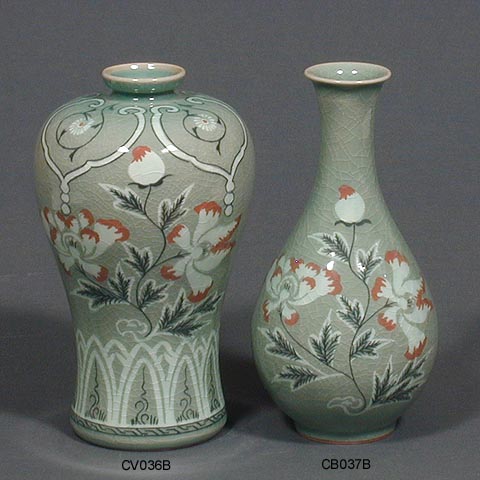
These days, to admire the real deal, you could head for Changdeokgung or Deoksugung sometime around May as it blooms in late spring. Unfortunately I doubt I'll have the chance to see this anytime soon, so I just have to try harder not to be so prejudiced against this pretty face and learn to appreciate its multi-faceted nature, whether it's immortalised on a vase...


or an antique teapot....


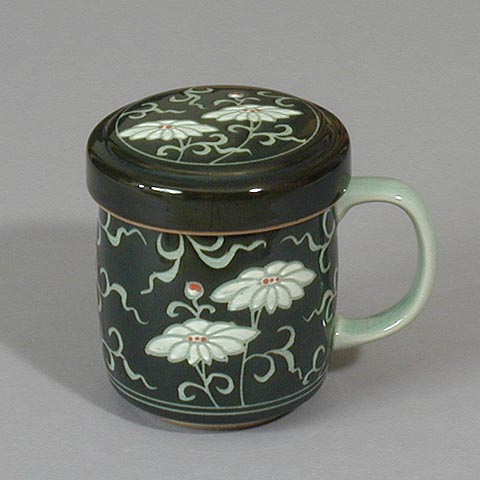
OR a modern coffee mug with cap....
on paper napkins  ( see above) or treasure chests ( see below)

or super-ornate rice bins or traditional pillow ends.


sources:
http://hompi.sogang.ac.kr/anthony/KimYeongNang.htm
http://www.theflowerexpert.com/content/mostpopularflowers/morepopularflowers/peonies
http://www.wpro.who.int/internet/files/pub/97/191.pdf
http://www.panoramio.com/photo/52282156
https://thinkingaboutlanguages.wordpress.com/2011/06/18/word-of-the-week-33/
http://www.newsfinder.org/site/more/tree_peony_the_soul_of_china/
http://www.korean-arts.com/images/CV036B-CB037B_pink_peony_5x5.jpg
http://www.koreaherald.com/entertainment/Detail.jsp?newsMLId=20110320000258
http://www.alibaba.com/product-free/103264528/Peony_Rice_Pot_20kg_.html
http://www.alibaba.com/product-free/11855002/Mother_Of_Pearl_Peony_Pirate_Chest.html
http://www.korean-arts.com/images/CS103%20peony%205x5.jpg
http://www.koreanartandantiques.com/items/1060871/en1store.html
http://www.moonscrafts.com/2011/07/korean-pottery-goryeo-sanggam-celadons.html
http://www.dhgate.com/new-arrival-peonies-stamped-wedding-napkins/p-ff808081318f593b0131addcc2897fef.html
http://www.liveauctioneers.com/item/8787806
http://www.greetingcarduniverse.com/thank-you-cards/korean/kamsahamnida-thank-you-in-korean-810799
http://teatrekker.wordpress.com/tag/chinese-12-flowers-of-the-months-teacups-chinese-flower-tea-cups/
http://primaltrek.com/impliedmeaning.html
http://iluvskating.tumblr.com/page/2