Showing posts with label Jeonju. Show all posts

Thursday, July 22, 2010

How Many Ways Can You Use A Hand Fan?

Doing this piece on Korean fans - no, not the kind who go after Kpop stars, but the hand-crafted ones as some Korean friends gave me a few beautiful ones recently. Plus,  summer seems the appropriate season to feature them.


Started drawing up a list of the ways in which Koreans have used fans and guess what? The number of  functions have now hit twenty! Let me count the ways, beginning with the traditional uses in terms of personal comfort as indicated in description of the “eight virtues” of the hand-held  fans :

1. Naturally they kept people cool in the summer heat. But how many people, in these days of battery-powered mini-fans, still use such eco-friendly devices?

2. The fan was also handy, not so much as a fly swatter, but to discourage insects from hovering around. Again, it was much greener than spraying insecticide.

3. Koreans working outdoors could also block off the sun rays by holding the fan to shade their eyes.

4. Instead of dirtying their hanbok when they had to sit on the ground to watch an outdoor performance, they sat on the open fan as a cushion.

5. It  protected the hair when the rustic folk had to bear large burdens of firewood etc on their heads.

The remaining three 'virtues' revolve around the domestic scene:

6. The fan acted as an  improvised cover for an open container
7. It was employed to fan hearth or kitchen fires
8. It could serve as a replacement for  a dustpan ?!

9. Sometimes, housewives used the fans to help them to sort out grains. ( though this wasn't included among the 8 virtues. )

However, fans served other important functions during the Joseon Dynasty.

10.  They were status symbols. Members of the royal family had the privilege of owning large fans which had 50 spokes. Fans flaunted by the yangban or aristocratic class were made of the finest quality paper and bamboo and decorated with precious metals or gemstones like amber or jade but they couldn't carry fans with more than 40 spokes. Ordinary folks had to be satisfied with poorer quality fans with much fewer spokes.

11.Fans were also significant to shamans ( mudang). The Shaman's Fan Painting (Songsubuchae) below has a fan within a fan. The female shaman on the right is holding a fan used for rituals as it has a "picture of the Sambul trinity who govern childbirth, life, and agriculture".  In one Korean dance, the performer who takes on the role of the mudang "captures the awakened souls with bu chae (fans) so they can rejoice with her and ease their suffering".


12. Pansori singers used the fan for dramatic effect while court performers entertained with the graceful fan dance or the buchaechum.


13. Artists would elevated the prestige of some fans when they showcased their skills in painting, calligraphy or composing poems. Such fans then were displayed as decorationns in the home.


14. Fans, of course, have long  been used as fashion accessories by ladies.


15. But they could also hide heir faces in genuine modesty or embarrassment or coyness. No doubt the kisaengs of the past practised the art of seduction by fluttering their lashes behind their fans.

16.  Fans were also bestowed as state gifts on foreign dignitaries.

17.  Ironically, some fans were used for far less diplomatic purposes - steel fans were once weapons  of stealth when the people were not allowed to bear swords in public. The art of making secret compartments which held razor blades or poisons must be a dying or dead art by now.


18 At the same time, a person skilled in martial arts could deflect knives and defend himself with a sturdy fan.

19. In these more commercial times, fans are curiosities recalling the past, reduced mostly to tourist souvenirs.

20. Finally, it has been adopted as a city symbol for Jeonju which still has a number of craftsmen who maintain this

sources:
http://alittlebirdietoldmeso.blogspot.com/2008_08_01_archive.htmlhttp://www.liveauctioneers.com/item/6668206
http://www.koreanartandantiques.com/items/803314/item803314store.html
http://en.wikipedia.org/wiki/File:Korean.Dance-Buchaechum-01.jpg
http://www.worldartswest.org/main/edf_performer.asp?i=2
http://www.koreanpress.net/news/view.asp?idx=2171&msection=1&ssection=3
http://joongangdaily.joins.com/article/view.asp?aid=2923236

http://www.antiquealive.com/masters/Hand_Fans/Korean_Paper_Bamboo_Fan.html
 http://www.koreana.or.kr/months/news_view.asp?b_idx=703&lang=en&page_type=list
 http://weaponhouse.blogspot.com/2009/10/mu-puche-korean-fan.html
http://www.visitkorea.or.kr/ena/SH/whatToBuy/whatToBuy.jsp?action=item&cid=996013
http://english.ohmynews.com/articleview/article_view.asp?menu=c10400&no=220218&rel_no=1
http://www.mfms2010.org/sub0903.php

Sunday, June 6, 2010

Free Rides From Seoul To Gyeongju and Jeonju

The Visit Korea Committee is certainly spoiling visitors - tourists can now enjoy free and comfy bus rides from Gwanghwamun area in downtown Seoul to Gyeongju and Jeonju.


1. Where?
  • Gwanghwamun area in downtown Seoul (Donghwa Duty Free Shop),
  • also free shuttle buses from Busan to Gyeongju ( from July 1)
2. When?
  • Every day of the week except Monday
3. How long does this offer last?
  • June 1, 2010 - December 31, 2010 ( so hurry! Make your weekend plans for day-tripping now!)
4. What times?
  • Click here for details
5. How do I get it?
  • Apply now at http://english.visitkoreayear.com (Korean, English, Japanese, Chinese)
  • "Sign up in advance through the Visit Korea Committee official home page at www.visitkoreayear.com (two tickets per person). If more than 28 people make reservations for any given day, there will be a random drawing to decide the winners of the free tickets. Winners will be announced on the homepage or individually notified by phone."
  • For more details on the free tickets, please email to qhyuni130@yahoo.com.
  • Inquiries: +82-2-6272-7301 (English) 
6. What are the perks beside the free round-trip ride?
  • The buses are comfortable 28-seaters, equipped with Internet connection, DVD systems with personal earphones, and various tourist guidebooks.
  • You also get free guidebooks of Gyeongju and Jeonju, a booklet about Korean culture and tours, a welcome-kit and a souvenir of “Visit Korea Year"
7. What are the drawbacks?
  • It seems to be only for day-trips and I can't imagine squeezing all the attractions of either city into a single day.
  • It's only for non-Korean nationals so if you planned going with a Korean friend, that would be tricky.
  • The drop-off and pick up point for Gyeongju doesn't seem very convenient as it is at the Bomun Lake Resort (Hyundai Hotel-Hilton Hotel-Concord Hotel) which is a distance away from the main attractions of Gyeongju. You'd have to get a bus or taxi to places like the tumulis, the museum, Seokguram Grotto or Bulguksa.

sources:
http://asiaenglish.visitkorea.or.kr/ena/FU/FU_EN_15.jsp?cid=1037293
http://www.visitkoreayear.com/
http://asiaenglish.visitkorea.or.kr/ena/SI/SI_EN_3_6.jsp?cid=996963
http://asiaenglish.visitkorea.or.kr/ena/SI/SI_EN_3_6.jsp?cid=794336

Tuesday, January 26, 2010

Jeonju Wish List - Jeonju Part 8

Here's my wish list for Jeonju if I get to revisit it!

a. Stay in  the Hanok Village for at least one night so I can do a leisurely, DIY walking tour of the place.
Didn't have enough time when I visited Jeonju back in 2003 with a tour group as we had spent almost the whole day at the Jeonju Traditional Cultural Centre. Here's a list within a list of places I'd like to check out in the Hanok Village which evolved as a kind of patriotic response to the Japanese occupation when the traditional Korean houses were in danger of being overwhelmed by Japanese style homes:

i. Gang Am Calligraphy Gallery - it' s hard to believe that this is the only calligraphy gallery in the country.My main interest here would be the paintings of  Dan Won also known as Kim Hong Do whose works were featured in the SBC TV drama, Painter of the Wind.


ii. The Jeonju Traditional Oriental Herb Culture Center, found on the Wooseok University campus. You may be able to get a traditional physician's analysis of your physical condition but I'm more intrigued by the prospect of  the Building Hanok Experience in the Outdoor Experience Yard ( do they really mean an honest-to-goodness hanok or just a miniature version?) if that's not possible, I'll settle for a herbal footbath.

iii.   Jeonju Traditional Hanji Center  & The Jeonju Craftworks Exhibition Hall - the Jeonju Hanok website mentions another activity which I'd love to do i.e.dyeing clothes using yellow soil water ( stupidly used to think they used persimmon juice!)


Where's the best bibimbap in town?

b. Sample all the best restaurants renowned for bibimbap and omogary


Omogary means earthernware pot and a delicious spicy seafood stew is usually served in it.


Jeonju's home to the Dano Festival as well as other festivals.

c. Visit the place during its various festivals such as the Film Festival and the Sori Festival.


d. Try making paper and admire the exhibits at the Paper Museum.

e. Hanbyukdang is a pavilion built in 1404 as the private cottage of Choi Dam, a high-ranking government official in the early Joseon Dynasty. It was built by breaking and sculpting a cliff on the skirts of Mt Seungam. People in old days called it “Han beok chung yun A” and regarded it as one of the finest eight sights to see in Jeonju. Hanbyeokdang is a pavilion with an octagonal roof, with 3 units in front and 2 units on the sides. It is located towards Namwon from Hanok village, and was built in 1404 (4th year of King Taejong) by Choi Dam. There is a cave underneath the Hanbyukdang, where there are still dome holes made by bombs during the Korean War.


sources:
http://hanok.jeonju.go.kr/FLSite/default.aspx

http://hanok.jeonju.go.kr/FLSite/ContentView.aspx?menuID=2&subID=7
http://tour.jeonju.go.kr/open_content/english/tour/noted_place/local/list.jsp
http://tour.jeonju.go.kr/open_content/english/tour/food/hanokmaeul.jsp
http://tour.jeonju.go.kr/open_content/english/tour/food/omogary.jsp
http://tour.jeonju.go.kr/open_content/english/culture/festival/dano_arts_festival.jsp
http://www.sorifestival.com/

Monday, January 25, 2010

Drum Class, Jeonju Part 7

Found this youtube posting for a drumming class which is very similar to the session I attended at the Jeonju Traditional Cultural Centre.
Take my hat off to the citizens of Jeonju and whoever else funded this project so that foreign visitors could enjoy a truly memorable hands-on experience on the traditional drums.


source: http://www.youtube.com/watch?v=-rd3CYDZIf0

Connecting the Dots at the Confucian Academy - Jeonju, Part 6

There were two reasons I woke up early in the morning to look for the Confucian Academy ( Hanggyeo) in Jeonju when I travelled in a tour group to Korea in 2003.


First the Lonely Planet described two ginkgo trees which were over 400 years old on the grounds of this old school. Wasn't going to pass up on the chance to see what the four century old trees would look like.

Second, when I was in Jeju on my very first visit to Korea in 2002, I'd met some gentlemen from Jeonju at a Confucian academy. They had made a special trip to the island for a special ceremony related to their position as Confucian scholars and their friendliness in inviting my friend and I to observe their rites had created an impression.


So when the opportunity to visit Jeonju came up the following year, I couldn't resist the chance to connect the dots. Trouble was, it was very early in the morning, no-one was around and the gates were locked. Had to be satisfied with the very minor achievement of actually locating the place ( a stone's throw away from the Hanok Village and the Traditional Cultural Centre ).  The trees didn't look terribly ancient to my untutored eye - half expected to see stilts supporting the older branches but the twin trees seemed to be holding up pretty well ( if I saw the right ones!)


Here are some other interesting titbits which I found on a website on Jeonju:

1. Ginkgo trees, which don't easily fall prey to insects, have a special significance for Confucian scholars as they symbolise an upright moral character which cannot be corrupted.
2. There are five big and old ginkgo trees on the grounds of the Confucian School. The one in front of the West gate is over 400 years old.


3. The ginkgo tree on the right side of Daeseongjeon in the Confucian academy is regarded as a bisexual tree as "male turned into female to produce ginkgo”.
4. According to a local legend , you can pass your important exams if you make a wish in front of the 250-year old ginkgo taken in front of Ilwok Gate.


If you happen to be in Jeonju and if your timing and luck are better than mine, check out this place and say "Hi" to the gentlemen scholars and the ginkgo trees for me.

source:
http://www.knto.or.kr/enu/SI/SI_EN_3_1_1_1.jsp?cid=264422&nearBy=tran
http://tour.jeonju.go.kr/open_content/english/tour/noted_place/local/view.jsp?idx=32&cpage=1&keycat=1&keycode=&keyword=
http://hsinhisn.pixnet.net/blog/post/23402611
http://hanok.jeonju.go.kr/FLSite/ContentView.aspx?menuID=3&subID=17

Friday, January 22, 2010

The Three Cs of Jeonju - Jeonju, Part 5

Those who've been to Singapore may have heard about the national 'concern' with the five Cs ( cash, credit card, condo, car and country club membership).  Jeonju has its own Cs - it has culture, cuisine and crafts and a great introduction to all three in one place is the Jeonju Traditional Cultural Centre which is part of the Hanok Village.


We were a bit puzzled when our tour bus stopped beside the nondescript building. What a stopover it turned out to be. Little did we know that this modest-looking centre contained a music theatre, a dining hall where visitors can experience hanjeongsik, kitchens where visitors can learn to cook Korean dishes, a civic education hall, a traditional wedding hall, a tea house and an open space for performances and outdoor games. We would pass through one hall to another, experiencing a wide variety of Korean culture in the space of a few hours.


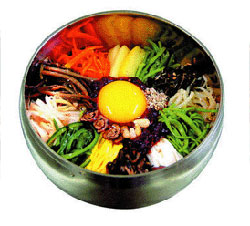
 We were delighted to discover many of the experiences would be hands-on. First up in the kitchen, we donned aprons and started slicing and frying up our julienned carrots, mushrooms etc to assemble our own bibimbaps in the kitchens specially designed for cooking classes. The photo below was taken from another person's blog as the kitchen  and aprons look very similar to the ones we used.


Making a good bibimbap is quite a bit of work. If you're truly fastidious, you'd julienne all the veggies into matchsticks of equal lengths and thicknesses. Next, you'd dutifully stir-fry each kind of veggie with just the right amount of sesame seed oil before assembling them oh-so-slowly, carefully and neatly in the ricebowl before serving it for your guest who will straightaway use the chopsticks to undo your painstaking, tidy arrangements unceremoniously in less than a minute.


Of course, my bibimbap didn't look as neat as the one above but I was  so eager to sample my creation, I forgot to take a pic. Later on, we were escorted into a spacious dining hall called Hanbyeongnu where an impressive banquet was waiting for us - it wasn't really hanjeongsik ( royal banquet) but you could've fooled me with the sizeable number of side dishes ( banchan) that we struggled to empty.


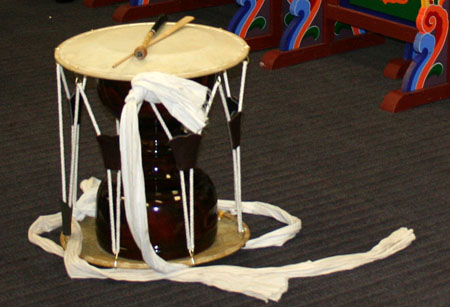
Next, we sat down for a short drumming class, using drums like the one below:


Imagine a bunch of tourists of different generations, from the five year old child to the seventy-plus grandma, all banging away in partial unison. Imagine, I mean, the sight and the sound. Not exactly a standard for Carnegie Hall but we all had great fun.

Later that night, we returned to the Traditional Cultural Centre for a pansori recital. It was in an intimate hall and we sat cross-legged on the floor for a riveting performance. I sat beside a  Korean teenager who was following the singing cum recitation with the entire script/ lyrics in her exercise book. Before we trooped out into the chilly autumn night, we passed by an exhibition displaying craft works using hanji (paper).

So anytime you wish to immerse yourself in an authentic Korean experience to enjoy its cuisine, culture and crafts, look no further than the Jeonju Traditional Cultural Centre near the Jeonju Hanok! HIGHLY RECOMMENDED!

For more on cultural experiences in Jeonju, click here.

sources:
http://english.visitkorea.or.kr/enu/SI/SI_EN_3_6.jsp?cid=799726
http://www.koreanculture.org/bbs/skin/webzang_gallery_trn/show_pic.php?file=data/news/DSC_8759.jpg
http://www.korea.net/cheditor40_asp/cheditor/attach/200792817234622594.jpg
http://oaklandnorth.net/wp-content/uploads/2008/11/drumming31.jpg
http://www.chf.or.kr/chf/eng/facilities/jt/jt.jsp
http://world.kbs.co.kr/english/event/korea_2009/sub01.htm

Thursday, January 21, 2010

How To Look At A King - Jeonju, Part 4

Used to think that portraits weren’t as interesting as landscape paintings or sketches of folk scenes. But after watching the SBS drama, Painter of the Wind, I’m now more inclined to give this genre more than a cursory glance.  Pity that I hadn't seen the drama series before I visited Gyeonggijeon in Jeonju. I would've spent a more enriching time there if I had known the following earlier:


Royal portraits ( eojin or ojin) were particularly important during the Joseon Dynasty as it had embraced the Confucianist tradition of ancestral worship. The Joseon kings had their visages depicted in portraits as a way of representing their “aspirations for the perpetuation of their dynasty”. When ordinary citizens bowed before the portrait of the king, it was as good as pledging allegiance to him. That's why Yi Song-gye, a.k.a. King Taejo, founder of the Joseon Dynasty, sought to validate his rise to power by a coup d’etat by commissioning no less than fourteen official portraits.

 Here's what I've gathered so far about the do's and don'ts of admiring portraits of the royalty in Korea.


1. DON'T march up to the shrine and hop over the low hurdle as if you're about to say Howdy to King Taejo. Instead, approach the shrine INDIRECTLY as a sign of respect. I guess eyeballing the royal portrait head-on  is a no-no as it can be interpreted as a sign of impertinence. That's why that low barricade is there in front of the entrance - to signal to visitors that they need to approach the portrait in an oblique fashion by using the side entrances.


2. Observe first the backdrop of the portrait. According to an article in the Spring 2006 edition of Koreana,  the "panels depicting the sun, moon and five peaks..( are) in accordance with the traditional practice.... In this way, the portrait of Taejo is being respected as if he were still the ruling sovereign". Strange thing is - I can't see any moon or mountains? We could be talking about different copies of portraits - the artists tended to make changes according to trends or personal preferences whenever they made reproductions so copies were never fully alike.

Also, the contrast between the simple lines of the figure and the details in the clothes, throne and carpet are intended to underscore the "authority and dignity of the king".


3. Note the position of the subject in the portrait. In most Joseon Dynasty portraits, the subject is seated at an angle but one has a straight-forward view of King Taejo. Some experts believe the perspective was meant to set him apart from the rest as the founder of the Joseon Dynasty.

4. Next, pay attention to the black headpiece perched on the head of the monarch. The ikseongwan has flaps sticking out from the back which symbolize a cicada's wings. Its "piercing sound is said to be expressive of sovereign dignity and its metamorphosis a symbol of rebirth".


5. Consider now the emperor's clothes...oops.. I mean, the king's clothes. He's decked out in blue ( "a carry-over influence of the Goryeo-style protraits") unlike late Joseon kings who preferred red.

6. Finally, take a close look at the face of King Taejo. Look out particularly for the mole above his right eyebrow. Portrait painters were careful to present unidealised faces of their sitters as the complexion reflected the personality of the subject. Verisimilitude of visage was so important to the Joseon kings that King Yongjo proclaimed that if a single strand of hair in the painting was different from the original, he would not consider that portrait to represent his ancestor.

So the scars, moles, pockmarks and other distinctive facial features had to be depicted as accurately as possible by the Joseon painters. Indeed, so faithful were they that Dr Lee Sung-nak was able to present a research paper, " An Analysis Of Skin Ailments Shown In The Portraits of the Chosun Dynasty"!
 Note: All quotes here are from Koreana, Spring 2006 edition.

Source:
http://www.koreatimes.co.kr/www/news/art/2009/12/148_7813.html
http://www.clickkorea.org/arts/curator/file/2-2_Portraits%20of%20the%20Choson%20Dynasty.pdf
http://koreana.kf.or.kr/pdf_file/1992/1992_AUTUMN_E034.pdf

Tuesday, January 19, 2010

Gyeonggijeon - Jeonju, Part 3

Our tour guide in September, 2003 was most anxious that we didn't miss this site during our stop-over in Jeonju.  At that time I wasn't in the right frame of mind to appreciate why he was willing to pass up on Pungnammun. Instead he was determined  that we spent a good part of an hour listening attentively to the local guide explain, not very coherently or clearly, the significance of this place. After all, most tourists come to the country without the benefit of Korean History 101 so a crash course in the various dynasties is likely to give the average person mental indigestion. Which comes before which -  Baekje or Joseon or Shilla?


Gyeonggijeon Shrine -a stone's throw away from Jeondong Cathedral

So very often, visits to sites of historical importance end up being clashes between the desire and pride of the patriotic and earnest Koreans who want to share their past and the befuddled foreigners  in packaged tours who can barely recall which city they were in the day before. Ironically TV dramas may help boost interest especially if one can relate the 3D reality of a building or temple to an exciting dramatic moment featuring some dashing general or unenlightened monarch with some ambitious concubine or vengeful lady-in-waiting.


To be honest, what mildly impressed me about Gyeonggijeon when we went there was its general atmosphere of peace and quiet. We had just emerged from  the noise of traffic and crowds in the city centre to find ourselves in this unexpected haven of tranquillity.


Though the shrine was enclosed within low walls, there was still a sense of space with long paths leading up to the main buildings.


The fact that the place was built to hold important artefacts like the portrait of the founder of the Joseon Dynasty, the mortuary tablets for a royal couple, palanquins ( see pic below) and a stupa housing some royal's placenta ( or is it umbilical cord?  See pic above) barely registered.


It was only after watching the TV drama, Painter of the Wind  a few years after that tour, that I had a better appreciation and stronger interest in royal portraits. Sometimes one can be in the right place at the wrong time. We were also probably too late to see the local seniors have their daily meetings here to play Korean chess or simply chit-chat. So we had to make do with the silent company of these figures mounted on the walls.


sources:
http://www.ocp.go.kr:9000/ne_dasencgi/full.cgi?v_kw_str=&v_db_query=A4%3A35&v_db=2&v_doc_no=00002437&v_dblist=2&v_start_num=131&v_disp_type=4
http://jikimi.cha.go.kr/english/search_plaza_new/EMapResultView.jsp?VdkVgwKey=13,03390000,35&queryText=(v_esidocode=35%3Cand%3E%20v_elcto=11)&strGuCode=11&strSidoCode=35&requery=
http://koreana.kf.or.kr/pdf_file/2006/2006_SPRING_E048.pdf
http://www.worknplay.co.kr/entertain/travel_view.php?num=497

Monday, January 18, 2010

Pungnammun - Jeonju, Part 2


When you're on a packaged tour, you're at the mercy of the tour guide who wants to stick to the given itinerary. So,  when I was in Jeonju in 2003, I was dismayed to find that no time was given for even a quick peek at National Treasure No 308. Hence, this posting is to make up for what I missed in this city, the birthplace of the Joseon Dynasty.


Pungnammun,  the symbol for Jeonju,  can be found in the southern part of the city. It is the only remaining gate from the original four that were part of the city walls built during the Joseon Dynasty(1768).  Partially destroyed during the Japanese invasions (1592-1598), Pungnam- mun  ( gate)  was finally reconstructed in 1978.


Take time to admire the double pavilion structure with its eight-layered roof. There are four old pillars on the first floor which continue up as pillars for the second level. Apparently this is an unusual characteristic for Korean gate pavilions. Decorative carvings, such as the heads of dragons, here are typical of the late Joseon period.


Pungnammun may be even more attractive at night if you're lucky enough to see it lit up like this!


sources:

http://www.knto.or.kr/cms/resource/71/167071_image2_1.jpg
http://www.knto.or.kr/enu/SI/SI_EN_3_1_1_1.jsp?cid=264412&nearBy=tran&

Sunday, January 17, 2010

Picture of Summer for a Wintry Day - Deokjin Park, Jeonju Part 1

Got a little weary of the stark whiteness of winter pics so I've decided to post a summery pic instead. Actually as my postings for the next few days will feature Jeonju, this photo of Deokjin Park serves as a sneak preview into this city.


Unfortunately I visited Jeonju in the wrong season - it was too late in September to see the lotus blooms cover the pond. ( The best months are July and August.) So my own photos turned out to be pretty dull instead of pretty in pink.

Citizens of Jeonju have Park Gi-soon to thank for being able to enjoy Deokjin Park for free as this wealthy gentleman donated this private park to the city in 1929. Much earlier,  the pond used to be part of a swamp before it was coverted into a moat to defend a castle which once stood here.


Ajummas from around the country used to wash their hair or even bathe in the waters of Deokjin as part of the ancient annual rites when they prayed to the sea deity for good health. These days, things are less exciting - just tourist groups who may exclaim with disappointment when they realise they're in the right place at the wrong time.

sources:
http://www.knto.or.kr/ena/SI/SI_EN_3_1_1_1.jsp?cid=313019
http://www.igougo.com/journal-j12910-Jeonju-Where_Dynasties_Begin.html#ReviewID:1152391

Monday, January 11, 2010

Isn't She Lovely?


If one could ascribe gender to temples, I'd call Geumsan-sa, a 'she'. There's something particularly feminine about her graceful curves and she does look particularly fetching dressed in the snowy-white mantle of winter, doesn't she?

On a more serious note, this temple is one of Korea's most important Buddhist temples. Believed to have been founded in 599 A.D. It developed into an important monastery in the 8th century and sadly like many other temples during the Japanese invasion in the 16th century, was razed to the ground and subsequently reconstructed in 1635. The Mireukjeon Hall, National Treasure No. 62, is the "only remaining three-storey traditional structure in Korea".

It's also probably one of the few buildings which has special names for each level. Daejabojeon (Hall of Great Mercy and Treasure) is situated on the first floor while the second floor is Yonghwajihoe (Gathering of Dragon and Beauty), and the third floor is called Mireuk-jeon (Hall of Maitreya). Pay attention as well to the supporting columns which get more and more slender, the higher they are.

A short drive from Jeonju, Geumsan-sa is also easily accessible by bus. For more information, click here.

source:
http://english.visitkorea.or.kr/enu/SI/SI_EN_3_6.jsp?cid=262538
http://www.orientalarchitecture.com/koreasouth/ruralchungbuk/geumsansa_gallery.php?p=geumsansa02.jpg