Showing posts with label Korea Regions. Show all posts

Wednesday, June 23, 2010

Wanna Win A Hotel Voucher For Seoul?

KNTO has launched an essay competition which will run until the 31st of July, 2010.  Share your experiences and photos of your holiday in Korea  to win a hotel voucher, passport holders or mobile phone charms. Click here for more information. Anyone interested? Don't know how popular this contest will be among those who aren't living in Korea - after all, one would still need to get the air ticket to claim the first prize. I once won a similar prize but never got round to enjoying the free stay in Korea because so much time had lapsed between the time the winners were announced and my visit to the country.

Credit: Pics from KNTO website.

Tuesday, April 6, 2010

Hwaseong,Suwon - A Fortress For A Father

Wish I had read Bruce Cumings' "Korea's Place in the Sun - A Modern History" before I visited Suwon. I would have appreciated Hwaseong fortress a lot more if I had a fuller picture of the sad Prince Sado then. As it was, it was a rushed visit to Suwon, coming at the tail end of my 2005 autumn tour. I'd taken the inter-city bus from Yongdae-ri into the city after spending a few peaceful days in Baekdamsa. Not exactly a wise move as the contrast between the idyllic setting in Soraksan National Park and the busy urban landscape was too jarring. Then it was a quick tour of the Korean Cultural Village just outside of Suwon before making the all-too-hasty decision to cover only the western half of the fortress wall as I was pressed for time.


Told myself that I'd complete the circuit in another visit. Ha - how optimistic I was. Now I have to be content to be an armchair traveller to revisit Hwaseong. Fortunately, there're a few interesting websites that I hope to explore more fully in the days to come. Plus, am re-reading the section from Cuming's book which describes how Prince Sado was forced to kill himself after his scandalous behaviour and how Hwaseong Fortress was eventually built by his son, Jeongjo, in memory of his late father.

Of course, the fortress isn't simply an elaborate shrine to commemorate one's parent. It was designed to repel invasions by the Japanese but it was also intended as an alternative capital. King Jeongjo evidently had a bone to pick with Seoul in more ways than one.

source:
http://asiaenglish.visitkorea.or.kr/ena/CU/CU_EN_10_4_3_1.jsp

Monday, March 15, 2010

Information Brochure for Jinhae Cherry Blossom Festival

I only learnt about the existence of this brochure when I made my way to Jinhae in 2007. There’s an electronic version which you can download the brochure for the Jinhae Festival at this website. Click here.


1. The 2010 schedule for the 48th Jinhae Cherry Blossom Festival has yet to be uploaded. A great pity for the non-Korean visitors who want to visit Jinhae this year. Timing is everything and one hopes the person responsible for the Jinhae City webpage can put up the detailed schedule for this year’s festival VERY soon. It would also be useful for foreign visitors to know which activities or events are suitable for them because some of these events or exhibitions may only be accessible to those who understand or can read Korean.

2. A more detailed map would be useful particularly to highlight bus-stops or shuttle bus routes.

3. The brochure could also include the bus schedule for the locations which are further away from the town centre. It’s not exactly a small town where everything is within walking distance and though there are shuttle buses, there’s little information about these as well in the brochure.

Here then are the websites for transportation to and around Jinhae:
Local buses http://eng.jinhae.go.kr/02/08_05.asp
Intercity buses http://eng.jinhae.go.kr/02/08_06.asp
Express buses http://eng.jinhae.go.kr/02/08_07.asp
Trains  http://eng.jinhae.go.kr/02/08_04.asp

source:
http://eng.jinhae.go.kr/

Sunday, March 14, 2010

Looking for "Romance" in Jinhae

It was love at first sight. No, I wasn't smitten by Kim Jae-won, the male lead in the 2002 MBC TV drama, "Romance" which also stars Kim Ha-neul. Instead, I fell in love with the array of cherry blossoms featured in the early part of the series. The moment I saw them, I just knew I HAD to visit the spot.


Took me a while to figure out the location but eventually I got round to planning a spring trip to Korea specially  to catch the blossoms on the cherry trees in the naval port of Jinhae in the spring of 2007.


There were two scenes I wanted to check out in particular: first, Anmin Road where the star-crossed lovers take a stroll along a beautiful promenade.


The second is  Yeojwacheon Stream (여좌천)  where the main characters, Gwanu and Chaewon meet on a bridge flanked by rows of cherry trees in full bloom on both sides. It's become known since the drama series appeared as the ‘Romance Bridge’.


Both scenes can be found in this music video, Unfortunately though, the person decided to go in for a sepia like effect so the original colours can't be appreciated here. Thanks to chioyochan for posting this MV.

sources:
http://asiaenglish.visitkorea.or.kr/ena/SI/SI_EN_3_1_1_1.jsp?cid=827152
http://koreanfilm.org/tvdramas/index.htm#romance
http://www.arirang.co.kr/Blog/Arirang_Town.asp?code=Bl5&id=&page=11
http://picasaweb.google.com/lh/photo/iX6z6lmoaBu7CGbD9OHizw

Tuesday, March 2, 2010

Much Ado About Magnolias

During my first visit to Korea during spring ( my very first  and only experience of spring in 2007), my mind was on cherry blossoms. But the first thing that caught my eye on the first day of that visit was a leafless tree just outside the main temple of Donghak-sa with elegant white blooms. Didn't know it at that time but I soon learnt I had just seen my first magnolias.

 목련꽃 "Mongnan - kkot" a.k.a. magnolias have started appearing in places like Jeju
- a sign that spring's just around the corner.

Here are some interesting things which I've just learnt about these "aristocrats of ancient lineage" as described by E.H. 'Chinese' Wilson. It's hard to believe but these trees existed even before the bees ( 20 -95 million years ago) so the flowers developed pretty hardy petals so that beetles could crawl into them to aid in pollination. The ancestors of these trees have survived ice ages  and continental drifts and now their progeny are scattered all over parts of Asia as far south as Sulawesi and as far west as Cuba.

 Who's lucky enough to live in an apartment next to a magnolia tree?

Magnolias also have a great track record as hardy trees which can deal effectively with air pollution so it’s not surprising to see them in town gardens. They have the enviable distinction of looking even more resplendent as they get older. Hmmm, maybe I should be reincarnated as a magnolia tree with creamy white or yellow or magenta blooms in my next life. ( just kidding).

Found this other comment by Orson S. Card which gave me pause for thought: .".. magnolias shed worse than cats. And not delicate little brown pine needles. These are big sloppy brown leaves, thick as cardboard and about the size of a brochure. On top of that, they drop ugly cones that are big enough you can sprain your ankle if you step on one in the dark." The Japs wouldn't agree with Mr. Card as they use the leaves of the magnolia obovata to wrap food and as cooking dishes in certain parts of the country.


Aside from looking extremely decorative, magnolia trees have proven rather useful. The Chinese have used the fragrant bark of M.officinalis ( hou po  OR 厚朴) as part of their traditional medicine as it's believed to have anti-anxiety properties and may help to  reduce allergic and asthmatic reactions. Buddhist monks in Haeinsa have turned the wood of silver magnolias into printing blocks for their sutras.


They've also been adopted as symbols - the white magnolia of Daejeon represents friendship while Siebold's Magnolia is the national flower of North Korea. The flowers stand for grace and elegance in the hearts and minds of most Koreans but for many Budhhists, the magnolias symbolize the attainment of nirvana after long and painful suffering.


Unfortunately my few pics of the magnolias didn't turn out so great with the overcast sky and the poor timing in the evening. So I'm grateful to those who've posted these lovely pics on the Net - thanks for sharing these magnolias with the rest of us!

sources:
http://en.wikipedia.org/wiki/Magnolia

http://www.youtube.com/watch?v=TT5wCejDrPU
http://www.independent.co.uk/life-style/house-and-home/gardening/full-of-eastern-promise-magnolias-are-a-magnificent-harbinger-of-summer-anna-pavord-takes-great-pleasure-in-finding-the-right-plant-to-suit-her-dorset-garden-744573.html
http://www.koreatimes.co.kr/www/news/opinon/2009/12/162_41949.html
http://www.lifeinkorea.com/travel/skyongsang/tripitaka.htm
http://www.mortonarb.org/tree-collections/taxonomic-groups/flowering-trees/magnolia.html
http://www.hatrack.com/osc/reviews/everything/2009-06-14.shtml
http://www.gaok.or.kr/eng/e03_infor/infor060.jsp

Saturday, February 27, 2010

An Informal Temple Stay, Naesosa Part 4


Love the way the ancient pine tree frames the main temple of Naesosa  ( Dae-Ungbojeon ).
What's distinctive about this building is that it was originally built without a single nail.

I love informal temple stays - first of all, most of the temples are usually situated away from the noise and pollution of cities and well-preserved in well-maintained national or provincial parks.  I can stay on the temple grounds, partake of healthy vegetarian meals, soak in the peaceful atmosphere of the temple as well as the wider surroundings which are usually pristine pieces of nature without having to follow a regimented schedule of marathon meditation sessions. Of course, I'm obliged to wake up before dawn to pay my respects to Buddha but I don't mind because it forces me to sleep earlier.

Fine  example of wooden carvings of lotus and chrysanthemum flowers on the flower Salmun ( doors).There are eight such doors on the front facade of the Dae-ung-bojeon.

Another plus of staying in the temple is that one can admire  the craftsmanship of temple architecture at a leisurely pace - something one can't do if one were to join a tour group or visit the temple as a rushed day trip. Moreover, you can admire the beauty of the temple surroundings in its different moods throughout the day - what's it like in the darkness before dawn? How does it look under the mid-day sun? Does it have the same atmosphere at twilight?


Die-hards of course may elect to stay longer to witness the changing of the seasons. In spring, Naesosa may not have that  many cherry trees but the ones that I saw were very pretty indeed. Perhaps they were even more attractive because there weren't too many of them on the temple grounds.


If you prefer to visit in autumn, the maple trees on this avenue leading to the temple are a charming sight as well. Winter is another evocative season when the snow-clad temple looks like the perfect setting for  inspiring Zen poems.


Another thing I like to check out in the temples in Korea is the water. There's something primeval whenever one sits around a bonfire and there's a similar feeling each time I quench my thirst with the spring waters of each temple. To drink, see and hear the cool waters trickling down the stone basins is a simple soothing pleasure one can never tire of during temple stays.


Was mentally rubbing my hands in glee when I first saw the sizeable pavilion housing the Dharma musical instruments as I thought I had the chance to listen to the monks doing their fabulous thing on the drums. But I was disappointed to find a watered-down version in Naesosa - not the same magical sounds that I'd heard in Baekdam-sa or Gap-sa or even Songgwang-sa. Maybe my timing was off for that night. I've found that different temples seem to have different approaches to the Dharma instruments.


The bronze bell, in Beomjonggakwas made during the Goryeo period. Three images of Buddha, called Samjonsang are engraved on it.

The original name of Naeso-sa was Sorae -sa , meaning "a place which one revisits to be reborn". It was enough for me to be rejuvenated during my brief temple sojourn. Check  into a temple without being in a group and even if ( or perhaps because ) you may not spend too much chatting with others, the peace and solitude may prove to be the perfect antidote to the stresses of city life. Try it and discover it for yourself.

sources:


Friday, February 26, 2010

Getting to Naesosa, Part 3


Getting there - take the bus to Buan Bus Terminal and then board the bus which goes around  Byeonsan-bando ( services are between 6 30 am and 830 am every 20 -30 minutes; trip to Naesosa takes about 50 minutes)


Get off at the Naesosa bus stop and walk past the usual row of shops, sikdangs ( restaurants) and minbaks to reach the fir-lined entrance to Naesosa.


The fir-tree avenue gives way to a broader path flanked by cherry and maple trees. BTW, this path was featured in one episode of Daejanggeum when the heroine played by Lee Young-Ae returned to the palace after taking care of a nanny to the royal family. The pond where the lead character, Janggeum sits mournfully throwing pebbles into the water after a tiff with her mentor, can be found on one side of this lane.


Fortunately for me, there was ample room for me to stay overnight in the temple, provided of course, that I followed their basic rules. In summer, I suspect, it would be difficult for single travellers to stay here as Naesosa is popular with groups who come for summer camps.

sources:
http://www.cha.go.kr/servlet/Download?fid=TWpBPQ==&tname=Y2hndWlkZQ==

http://search.korea.net:8080/intro_korea2008/travel/pdf/01_19.pdf

Monday, February 15, 2010

Waiting for the Sunrise, Naksan-sa Part 1


I thought I did everything by the book – set my alarm clock and wake up early before dawn , find my way from my minbak near Naksan beach and up a hill to Naksan-sa ( temple). Then creep tentatively without benefit of torchlight in the autumnal dark to Uisangdae ( pavilion). Spend at least thirty minutes shivering in the cold and dark, waiting for the famous sunrise and guess what happens?

Nothing.

Above and  below: The sunrise pics which I wanted to take but couldn't

True, the sky lightens and the presence of some Korean tourists who appear a little while after I do, reassure me that I’m in the right place but alas, there are too many clouds obscuring the spectacular dawn which I was hoping to see.

So to console myself, I pay closer attention to the octogonal pavilion itself which is a 1925 reconstruction of a pavilion where the famous monk,Ui-sang used to meditate.


It was also the place that provided inspiration for the Joseon poet, Songgang Jeongcheol. Here’s my reworking of his verse:

After the pear blossoms have fallen,
Mid the cuckoo’s sad laments,
Beyond the hill east of Naksan at Uisangdae,
I rise in the darkness to wait for the dawn.
The brightening clouds are flowers blooming
And the sun’s a precious stone held up by six dragons.
It ascends in majesty from sea to sky and
The whole earth trembles as it rises swiftly,
Brighter than a thousand candles.


With or without the dawn, the Uisangdae's a pretty place with great views of the sea.


sources:
http://www.buddhapia.com/buddhapi/eng/temple/korexp/html/bu11.html
http://asiaenglish.visitkorea.or.kr/ena/SI/SI_EN_3_1_1_1.jsp?cid=312871
http://asiaenglish.visitkorea.or.kr/ena/SI/SI_EN_3_6.jsp?cid=309343
http://english.triptokorea.com/english/viewtopic.php?t=5925
http://eng.koreatemple.net/travel/view_temple.asp?temple_id=32
http://www.koreanbuddhism.net/jokb/press/view.asp?article_seq=5865&page=1&search_key=&search_value=
http://www.knto.or.kr/enu/SI/SI_EN_3_1_1_1.jsp?cid=264186&nearBy=site&
http://www.kimsch.net/flash/dream-en.swf
http://www.land.go.kr/gTra.do?tra=enudestination&cid=3204
http://german.visitkorea.or.kr/ger/SI/SI_GE_3_1_1_2.jsp?cid=335521

Wednesday, February 10, 2010

Oseam, Baekdamsa Part 4

On my long list of places I'd like to check out in Korea, Oseam may seem a choice as obscure as the actual location of this tiny hermitage in the north-west quarter of Soraksan.


It was built in 644 during Queen Seondeok's reign during the Shilla Dynasty. From what I can gather from the contours of the map, it's at least at least two hours' walk from Baekdamsa ( which is remote in itself, if you don't take the soft option of the shuttle bus).


So why would I want to visit this spot?


First of all, with Gwaneumbong as its backdrop, it promises to be a pretty spot with great views of Soraksan. Next, I'm curious to see how this place inspired Manhae as he spent quite a number of years as a monk who also composed poems here


Next, "Oseam" which means "five year old temple" got its name from a local legend. It tells of a five-year-old boy who, stranded in a remote temple, prays to be reunited with his mother. Some miracles of nature apparently happen and so the temple since then has kept the memory of this boy alive through its name.

Now the story is assured of a little more longevity, thanks to the animated movie by the same name directed by Sung Baek-yeop.

Though it wasn't such the box office as hoped because it was released about the same time as Spirited Away, it won the grand prize for the short films category at the Annecy International Animated Film Festival.


I stumbled upon the DVD at a shop in Incheon International Airport while waiting for my flight home and it was only then that I had heard of the place. Thought it would be a nice Christmas gift for a child but ended up watching it instead. It's a pretty, charming and modest film though I'm not too comfortable with its ending.
Still, it's a home-grown Korean anime which strives to achieve its own distinct voice.

For an interview with the director, click here.

sources:
http://guriguriblog.wordpress.com/2009/02/09/oseam-commentary-translated-in-englis/
http://koreanfilm.org/kfilm03.html#oseam
http://www.themanime.org/viewreview.php?id=513
http://www.anime-planet.com/reviews/a591.html
http://www.answers.com/topic/oseam
http://english.visitkorea.or.kr/enu/SI/SI_EN_3_1_1_1.jsp?cid=790281
http://movie.subtitlr.com/subtitle/show/175336
http://asiaenglish.visitkorea.or.kr/ena/HA/content/cms_view_316264.jsp

Friday, January 29, 2010

How To Organise A Winter Festival, Korean-Style

Here's a brief and totally frivolous guide on how to hold a winter festival, inspiration courtesy of  the Inje Icefish Festival, currently held in Gangwon Province.

1. First, you need a cute mascot
....to helm your festive activities. This blue fella here reminds me of Doraemon but I can't decide if he or she's an otter or seal or some other creature.

2. Give visitors something to look forward to...
...such as fish they can savour on the grill at the end of the day. Make sure visitors have high chances of success so as to encourage annual returns to the festival. The smelt, a small silvery fish (Osmeridae family),  is easy to catch with basic fishing gear and is found in abundance during winter so it makes a great focal point for the Inje Festival. For more tips on how to catch your smelt, click here.


If Dads are too engrossed to teach the kiddies how to hook the bait, there are fishing classes for children.


3. Make sure your ice fest caters to all interest groups.
As the unofficial slogan for the Inje Ice Fest goes: "Ice fishing for dads, Smelts dishes for moms, Ice park for kids, Exotic dating courses for couples, and lots of recreations and winter sports to participate!"


3a. Haven't a clue what the exotic dating courses for couples means actually - I'm guessing either a bland ride around the lake in some snow sled or are there tiny igloos for couples to get really close and cosy?

3b. Give the foreigners something truly exotic to write home about  or post on their blogs by having contests to see who can eat the most raw smelt.


Remember to hold cooking lessons featuring recipes using smelt  for ajummas who may not fancy their fish raw.

3c.  Arrange for sporty visitors to take part in  matches on the ice or competitive games such as football or  tug-of-war.


3e. Don't forget those attracted to intellectual games - they can even play Chinese chess with the ice as their enlarged chessboard.


For full schedule for the 2010 fest, click here.


3f. Be prepared to cater to the variety of  interests - from kids who prefer to race each other to animal lovers who'd watch a real dog race to those who prefer more passive sports like playing PC games such as the one below.


sources:
http://world.kbs.co.kr/english/news/news_photo_detail.htm?No=14315 ( pics from Yonhap News )
http://english.visitkorea.or.kr/enu/SI/SI_EN_3_2_1.jsp?cid=292929
http://images.google.com.my/imglanding?q=inje%20ice%20festival&imgurl=http://english.visitkorea.or.kr/cms/resource/90/673990_image2_1.jpg&imgrefurl=http://english.visitkorea.or.kr/enu/SI/SI_EN_3_2_2.jsp&usg=__ywJQHCIlBjHxFtPGrLHExMPZg7g=&h=333&w=500&sz=74&hl=en&um=1&tbnid=hJpm0jwgraZyzM:&tbnh=87&tbnw=130&prev=/images%3Fq%3Dinje%2Bice%2Bfestival%26hl%3Den%26sa%3DN%26um%3D1&sa=N&um=1&start=3#tbnid=hJpm0jwgraZyzM&start=7
http://www.injefestival.co.kr/english/sub3/sub5.asp
http://adventureteachingkorea.wordpress.com/
http://www.gamesetwatch.com/2009/04/koreas_dogsledding_mmorpg_husk.php
http://www.youtube.com/watch?v=ISKh68C-Hxk

Friday, January 22, 2010

The Three Cs of Jeonju - Jeonju, Part 5

Those who've been to Singapore may have heard about the national 'concern' with the five Cs ( cash, credit card, condo, car and country club membership).  Jeonju has its own Cs - it has culture, cuisine and crafts and a great introduction to all three in one place is the Jeonju Traditional Cultural Centre which is part of the Hanok Village.


We were a bit puzzled when our tour bus stopped beside the nondescript building. What a stopover it turned out to be. Little did we know that this modest-looking centre contained a music theatre, a dining hall where visitors can experience hanjeongsik, kitchens where visitors can learn to cook Korean dishes, a civic education hall, a traditional wedding hall, a tea house and an open space for performances and outdoor games. We would pass through one hall to another, experiencing a wide variety of Korean culture in the space of a few hours.


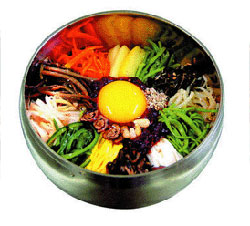
 We were delighted to discover many of the experiences would be hands-on. First up in the kitchen, we donned aprons and started slicing and frying up our julienned carrots, mushrooms etc to assemble our own bibimbaps in the kitchens specially designed for cooking classes. The photo below was taken from another person's blog as the kitchen  and aprons look very similar to the ones we used.


Making a good bibimbap is quite a bit of work. If you're truly fastidious, you'd julienne all the veggies into matchsticks of equal lengths and thicknesses. Next, you'd dutifully stir-fry each kind of veggie with just the right amount of sesame seed oil before assembling them oh-so-slowly, carefully and neatly in the ricebowl before serving it for your guest who will straightaway use the chopsticks to undo your painstaking, tidy arrangements unceremoniously in less than a minute.


Of course, my bibimbap didn't look as neat as the one above but I was  so eager to sample my creation, I forgot to take a pic. Later on, we were escorted into a spacious dining hall called Hanbyeongnu where an impressive banquet was waiting for us - it wasn't really hanjeongsik ( royal banquet) but you could've fooled me with the sizeable number of side dishes ( banchan) that we struggled to empty.


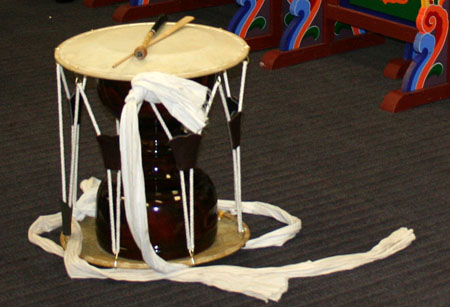
Next, we sat down for a short drumming class, using drums like the one below:


Imagine a bunch of tourists of different generations, from the five year old child to the seventy-plus grandma, all banging away in partial unison. Imagine, I mean, the sight and the sound. Not exactly a standard for Carnegie Hall but we all had great fun.

Later that night, we returned to the Traditional Cultural Centre for a pansori recital. It was in an intimate hall and we sat cross-legged on the floor for a riveting performance. I sat beside a  Korean teenager who was following the singing cum recitation with the entire script/ lyrics in her exercise book. Before we trooped out into the chilly autumn night, we passed by an exhibition displaying craft works using hanji (paper).

So anytime you wish to immerse yourself in an authentic Korean experience to enjoy its cuisine, culture and crafts, look no further than the Jeonju Traditional Cultural Centre near the Jeonju Hanok! HIGHLY RECOMMENDED!

For more on cultural experiences in Jeonju, click here.

sources:
http://english.visitkorea.or.kr/enu/SI/SI_EN_3_6.jsp?cid=799726
http://www.koreanculture.org/bbs/skin/webzang_gallery_trn/show_pic.php?file=data/news/DSC_8759.jpg
http://www.korea.net/cheditor40_asp/cheditor/attach/200792817234622594.jpg
http://oaklandnorth.net/wp-content/uploads/2008/11/drumming31.jpg
http://www.chf.or.kr/chf/eng/facilities/jt/jt.jsp
http://world.kbs.co.kr/english/event/korea_2009/sub01.htm