Tuesday, February 9, 2010

Who's a Buddhist Priest, Nationalist Fighter and Poet Rolled into One? Baekdamsa Part 3


Aside from former President Chun Doo-hwan who spent a few years in Baekdamsa,  Manhae, a.k.a. Han Yong-un ( 1879-1944)  is the other person with close associations with this remote temple in Gangwon-do. He was one of the 33 signatories for the historic document which contained Korean's declaration of independence from Japan.  He spent some time in Oseam, a hermitage under Baekdamsa where he was ordained as a monk and the temple now has exhibitions dedicated to his life and works. There's even a festival dedicated to him.

Yom Moo-ung on his poems: They "can be read by the young as love songs, by the religious as words of salvation and by mankind as watchwords that convey the ardent desire for national independence."

Koreans study and recite his poems in high school such as the two works which I've quoted in a previous posting so today I'm just including a snippet from his poem, " Envoi: To My Readers" as an introduction to his works ( rewording and line breaks are my own):

In time to come, reading my poems
may be like sitting among the flowers
of late spring
and rubbing a withered
chrysanthemum
and holding it under the nose
for its scent.

For more poems, click here.

sources:
http://www.koreatimes.co.kr/www/news/art/2008/08/203_26966.html
http://manhaeprize.org/manhaeprize/bbs/board.php?bo_table=literary_world&wr_id=1&page=&sca=&sfl=&stx=&sst=&sod=&spt=&page=
http://www.manhaeprize.org/ebook/myloveebook/lifewz.htm
http://www.korea.net/News/News/newsView.asp?serial_no=20071214012&part=108&SearchDay=
http://www.buddhistchannel.tv/index.php?id=10,2059,0,0,1,0
http://world.kbs.co.kr/english/culturenlife/culturenlife_istory101_detail.htm?No=36
http://homepages.wmich.edu/~b9park/HY.htm

Monday, February 8, 2010

Staying Next to the Presidential Suite in Baekdamsa, Part 2

Don't think there was any official templestay in Baekdamsa way back when I visited the place in this quieter spot in Seoraksan, Gangwondo in 2004 but I was lucky enough to be allowed to stay there. Found that my room was just next to the room once occupied by former President Chun Doo-hwan when he went into a self-imposed exile of less than three years in the late 1980s.


President who? He's the one who imposed martial law and gave the green light for the Gwangju massacre when at least 207 people were killed and 987 hurt while protesting against his unconstitutional disbanding of the National Assembly. He escaped a death sentence imposed in 1996 when President Kim Young-sam pardoned him.


Cynics would say the exile was more like a convenient retreat to escape the publicity and media while his supporters would applaud the move to this remote spot in Gangwon-do as a sincere act to repent for what he had done. Two years of eating vegetarian food, waking up before dawn to do 108 prostrations, chopping firewood and doing other menial chores alongside his wife - was that his escape route or a fitting punishment for a disgraced President?

source:
http://www.buddhistchannel.tv/index.php?id=45,6738,0,0,1,0
http://www.absoluteastronomy.com/topics/Chun_Doo-hwan
http://www.baekdamsa.org/contents/sub5_2.php?mode=view&page=1&uid=3082&secret=&key=subject&search=
http://www.answers.com/topic/chun-doo-hwan-1

Baekdamsa Revisited, Part 1

It's not a state secret but I'm still loathe to write about Baekdamsa. I'd like to keep this place selfishly  to myself but who am I kidding? The place that I visited in autumn, 2004 has probably changed a lot. Besides, who was it who said you can't step into the same river twice?

Baekdamsa, Temple of a Hundred Pools, lies in a quiet north-western corner of Soraksan. "Quiet" is a relative term - it's spared the massive crowds that descend on the main section of this popular national park but at the same time, don't be surprised to see a long line of people along this bridge that leads to the temple. Busloads of ajummas and local tourists can make this place quite noisy at times but if you head out for the trails, it's easy to think that you may be the only visitor.

Then again, the piles upon piles of stones built by past visitors remind me that I'm just one of countless visitors who have been fortunate enough to make our way to this place.

Here's another pic to put one in a solitary mood - can only imagine the beauty of the wintry solitude in Baekdamsa. Whichever season you choose, do check the shuttle bus schedules that takes passengers from the village of Yongdae-ri to Baekdamsa ( 3.5 km, 2,000 won). I arrived by a local bus from Sokcho and just missed the last shuttle bus in the late afternoon so had to spend one night in Yongdae-ri as I wasn't prepared to lug my backpack for that distance. On hindsight though, I should have not spent the night in Yongdae-ri. Not that it was hard to find a decent yeongwan but the walk would've given me more time to count the pools along the way.

Here's an alternative route: At Inje Terminal, take a bus to Wontong or Jinburyeong and get off at Yongdae-ri. (40 minute interval, Runs 20 times a day)

sources:
http://www.visitkorea.or.kr/enu/SI/SI_EN_3_1_1_1.jsp?cid=264231
http://en.wikipedia.org/wiki/Baekdamsa
http://www.koreanculture.org/06about_korea/symbols/09seoraksan.htm

Friday, February 5, 2010

One More For The Road.....from Drunken Tiger

I've been going ga-ga over tigers in this blog lately in the run-up to Seollal and to usher in the Year of the White Tiger. But here's my last posting on tigers ( I think but can't promise!)

Just heard on KBS World Radio that Drunken Tiger just recently won the Best Album and Hip Hop Award at the 19th Hi - One Seoul Music Awards on Wednesday this week. Drunken Tiger was the Korean-American hip-hop group that eventually became a one-man show

The first song that I liked was Liquor Shots way back in 2006. Am still clueless about what they're singing and I can't explain why I like it. Let's just say it's quite infectious.


DRUNKEN TIGER 7TH ALBUM MV
8:45 Heaven was written when DK Tiger's grandmother passed away.


Lyrics for 8:45 Heaven. Thanks to Scottahn for posting the video and the English translation on youtube.

I should've done better when you were here
I should've told you when you could hear
that morning which had no difference
I already felt by the ring which woke me up
it's too late to put back the time
One last cry. oh please god try
please don't let her die on me I know it's a lie
I told you to wait for me to make you happy
you told me that you'll wait till I rise to the top
please endure it bit more, don't leave this world
God please pretend as you've never saw it just for once
it must be a mistake, god is not also perfect
he's trying to take the most precious thing in the world


[CHORUS]
8:45 you're going up to heaven, the peaceful world where only virtue exists
8:45 you're going up to heaven, if you can hear me..know that I love you
8:45 you're going up to heaven, the peaceful world where only virtue exists
8:45 you're going up to heaven, if you can hear me..know that I love you


[VERSE 2]
Holding your speachless hand..I just yell out that you might hear if do so..
please wake up, open your eyes
One last cry Let me say good bye
please don't let her die on I know it's a lie
even the world hates me I'm your best
no matter what people say you never blamed me the question less love..
that's the thing like God which makes miracle, the perfect, perfect beauty after God
The most beautiful  thing in the world
the most precious thing in the universe my love

[VERSE 3]
where did you go without your last goodbyes
My heart is filled with pain
Tho I drive 'em out with a deep sigh
Only pain remains
I see nothing in this empty world
But I try to smile
You might be sad if you see me so sad
I promise you I'd never ever forget you
I'mma let go of your hand

sources:
http://www.youtube.com/watch?v=zY2R-gr0opE&feature=related
http://world.kbs.co.kr/english/entertainment/enter_artists_detail.htm?No=10194
http://en.wikipedia.org/wiki/Drunken_Tiger
http://www.youtube.com/watch?v=U1jP4xS_mTY

Thursday, February 4, 2010

Ipchun

Thursday is Ipchun or the official beginning of spring according to the lunar calendar used by the Chinese and Koreans.``Ipchun'' is one of the 24 seasonal divisions that mark the start of spring. It is characterised by mild easterly winds chasing away the winter frost, bugs awakening from their long winter sleep  and fish shrugging off their sluggish habits to swim more actively beneath the icy layers of lakes and ponds.


Apricot blossoms are another sign that warmer spring days are around the corner.


Some ladies admiring pussy willows in Busan


A foreigner maintains a Korean tradition. Koreans used to stick papers called ``ipchuncheob'' on the ceiling or above entry ways to welcome the new season. The papers would carry hopes for the new year such as  "Ipchun daegil" meaning "Great Fortune in Spring" or "Spring Leads to Paths of Greatness" OR ``Geongangdagyeong '' which stands for "Happiness and Fortune Arriving With Spring".

Cute kindy kids in hanbok, posting couplets written in hanja at the gates of the Namsangol Hanok Village in downtown Seoul. The greetings read, ‘Welcome Spring With All Blessings,’ and ‘Spring With All Fortune.’
from Korea Times,  Photo by Shim Hyun-chul


 Ipchun is also the time when halmeonis and ajummas get together to make doenjang ( fermented soypaste).

Can you feel the east wind blowing and hear the ice melting now?

Sources:

http://english.chosun.com/site/data/html_dir/2010/02/05/2010020500249.html
http://english.chosun.com/site/data/html_dir/2010/02/04/2010020400309.html
http://www.koreatimes.co.kr/www/news/nation/2009/02/115_38787.html
http://www.korea.net/news/news/newsView.asp?serial_no=20090130013&part=106&SearchDay=
http://www.koreatimes.co.kr/www/news/tech/2009/02/115_38907.html
http://www.koreatimes.co.kr/www/news/art/2009/12/153_39068.html

When Interpreter's Blooper Translates Into Gift Of Siberian Tigers

Sometimes it pays to be linguistically-challenged.

Here's the story extracted from the English news of the Chosun Ilbo:

While visiting Korea in June, a Russian delegation .... went to the National Institute of Biological Resources... to see a display of mounted animals, including a Siberian tiger. During the tour, a Korean official said, "Korea is very interested in Siberian tigers." But the interpreter mistranslated the comment, and asked about Russia's willingness to donate the animals.

In response, Kirillov asked if Korea could raise donated tigers in the wild.The government didn't give much thought to the remarks at the time, but it seems Kirillov proposed the donation while briefing Russian Prime Minister Vladimir Putin on his visit to Korea....A ministry official said Russia agreed to donate the tigers to mark the 20th anniversary of the establishment of diplomatic ties between the two countries.

So Koreans can look forward to seeing more creatures like this:


source:
englishnews@chosun.com / Nov. 10, 2009 08:52 KST
http://upload.wikimedia.org/wikipedia/commons/4/49/Siberian_Tiger.jpg

Wednesday, February 3, 2010

Five Smoking Tigers

Came across this quaint expression. It's the Korean version of "Long, long ago":
호랑이 담배 피던 시절 (Horang-i dambae pidun sijul.)

Translated, it means: A time when tigers smoked cigarettes. According to Cho Ah-mi, this proverb refers to a time gone by. It is used to express that is very outdated.

This led me to google for images featuring smoking tigers and whaddaya know - I found four!


Smoking Tiger No.1 - I love the stripes in the tiger here. This "Smoking Tiger” is by Suh Gong-im and it was completed in 1997. Look for the original in  Lotte Gallery.


 Smoking Tiger No. 2 - This fella looks a little ridiculous on account of that silly top hat. This tiger looks too preoccupied to have any chat with the magpies.

"Jakhodo" is a genre of folk painting which features a tiger and one or two magpies. It was a custom for Koreans to hang such pictures on the walls of their homes at the beginning of the year. "The two animals were depicted together because it was believed tigers fend off evil while magpies invite good luck" and the pine trees in the background represent longevity.
Smoking Tiger No. 3 - Now is that a long pipe or an extra long toothpick? The rabbits in this pic as well as in Pic No 1 may be inspired by an old folks' tale about how three rabbits outwitted one hungry tiger by persuading him to spend his time smoking and fishing for food with his tail in a stream. The silly creature got trapped when his tail froze in the stream and so the rabbits enjoyed a season of roaming on the range free from worrying about being the tiger's next meal.


Smoking Tiger No 4 - Here's another one portrayed alongside rabbits AND magpies AND pine trees.


Finally, here's Smoking ( or rather Soon- to -Stop-Smoking ) Tiger No. 5! See previous posting.

 Here are three other proverbs provided by Cho Ah-mi:

호랑이도 제 말 하면 온다. (Horang-ido jemal hamyun onda.)
If you talk about the tiger, the tiger will appear.
Meaning: "Speak of the devil." This proverb is used to express an unexpected coincidence.


호랑이 굴에 가야 호랑이를 잡는다. (Horang-i gool-e kaja horang-ilul japneunda.)
If you want to  catch a tiger, you have to go to the tiger’s cave.
Meaning: If you want achieve a goal, you have to go to the source, work hard and overcome difficulties.


 호랑이에게 물려가도 정신만 차리면 산다. (Horang-ieke japhyudo jungsinman charimyun sanda.)
Even if you are caught by a tiger, you will survive if you keep your cool.
Meaning: Even when  facing the most dangerous situation or difficulty, a person can survive if he keeps his composure and does not lose his cool.
This proverb teaches people to be courageous and not to despair even in the most desperate situations.

 I still like the first proverb the most!

Source:
http://joongangdaily.joins.com/article/view.asp?aid=2914997
http://www.flickr.com/photos/29837411@N00/42282614/
http://ieas.berkeley.edu/cks/k12/lesplan1_pro.doc 
 http://onceuponatiger.blogspot.com/2009/09/story-number-one.html

Tuesday, February 2, 2010

In The Mood For Tigers

Have been exploring cyberspace for Korean tigers in the art world. Here's what I've found so far:


This hanging scroll painting is the work of Kim Hongdo ( see earlier posting on Painter of the Wind)  and Im Huiji. Entitled "Tiger and Bamboo", it can be seen in Dokwon Art Museum. Seoul. Question is: Did Kim Hong-do paint the tiger or the bamboo? I'd like to think he can take credit for the former. If so, it's truly amazing how he can master so many different styles of painting. See his portraits of ordinary Koreans - his family on the road and his depiction of a Confucian scholar with his students.


"Korean Tiger" was the official catalogue published  in 1984 in the run-up to the 1988 Summer Olympics in Seoul.

The folk painting, "Magpie and Tiger" from the Joseon Dynasty has even  been reproduced for mouse-pads. Koreans used to believe that a  magpie indicated good news and luck while the tiger was used to ward off evil or bad luck.  The "combination of the bird and tiger hung inside a house reflected the people's wishes that the folk painting would bring them good luck and repel evil spirits". And there I was, the philistine, thinking, "How cute - the carnivorous king of the jungle having a cosy chat with a birdie!"


"The Korean Tiger - Exploration of the Underlying Culture of Korea 1"  is edited by Kim Ho-geun & Yoon Yul-soo (ISBN 89-301-0701-X)  "This book includes all aspects of real and imaginary tigers including extraordinary tiger paintings, beliefs and customs related to tigers, the ecology of tigers, Korean medical therapy and tigers, the literature on tigers, and proverbs related to tigers." The first publication was  in 1986, while another  appeared in the "Year of the Tiger” in 1998.

update ( 11 Feb 2010), click here for more on 2010 as the year of the White Tiger.

Sources:

http://www.inform.umd.edu/Caprina/Images/Sandler/004.gif
http://www.inform.umd.edu/Caprina/classes/ARTH489.htm
http://www.san-shin.org/order4.html
http://english.peopledaily.com.cn/90001/90782/6851592.html
http://www.zazzle.com/magpie_and_tiger_korean_folk_art_mousepad-144917239644885310

Monday, February 1, 2010

Any New Year Resolutions for the Year of the Tiger?

For those who missed making new year resolutions on the 1st of January, 2010, here's another chance for you to stiffen your resolve and find the determination to kick some bad habits. That seems to be the message from one pharmaceutical company that's doing its best to inspire Koreans to kick their nicotine addiction by using the character of the Tiger in line with the upcoming Seollal celebrations.

I refused to make any resolutions as 2009 gave way to 2010 but some things just have to get done. The annual spring-cleaning of the house, for instance so please excuse the brief postings for this period.


Sunday, January 31, 2010

Shopping for Seollal?


Don't know what gift to get your Korean boss, neighbour, friend or sweetheart for Seollal? Try some attention-grabbing gift packages like the gift box above available at Hanhwa Galleria.

Each set of four ostrich eggs costs  250,000 won ($223) and has four ostrich eggs. Why on earth would anyone want to give someone ostrich eggs,  you ask?

1.The size is impressive and seems to suggest abundance.

2. Koreans seem to love eggs - witness how often it's sold as a snack in jjimjilbangs and on board trains. Though I wouldn't recommend cracking an ostrich egg on your beloved's head as they do on K dramas!

3. Ajummas in a hurry in the kitchen can save time cracking several eggs to make their omelettes. Just crack one and voila! You've got enough to feed at least three people. Correction: On second thought, make THAT 20 people.

4. The shells would make great containers,  decorative and conversational pieces after you've emptied out the yolks and whites and cleaned them up.

Of course, if you don't find the notion appealing, you can opt for more conventional gifts like those below.


Sources:

http://joongangdaily.joins.com/article/view.asp?aid=2916020
http://asiaenglish.visitkorea.or.kr/ena/SI/SI_EN_3_6.jsp?cid=505985
http://www.koreaherald.co.kr/NEWKHSITE/data/html_dir/2010/01/13/201001130051.asp

Friday, January 29, 2010

Missing Bobby Kim

Deep sigh - so near yet so far. Commitments make it impossible for me to make it to the Esplanade Concert Hall in Singapore next week on the 1st and 2nd of February where Bobby Kim will be performing with composer/ lyricist/ arranger Oh Joonsung, Mario and Shinee.

Singaporean fans of K dramas are bound to have a great time as Mr Oh  will conduct his 9-piece band, Green Cacao alongside a 23-piece orchestra specially put together for the concert as he presents a number of his OST hits from popular K dramas such as My Girl and Boys Over Flowers. Other Kpop stars, Mario and Shinee will also delight their fans by appearing as well for the two- night concert.

It matters zilch to me that I won't be there in the Concert Hall to hear them but oh, Bobby Kim - that's another matter. (....Sound of another deep sigh from ajumma).

To console myself, I'm pinching this music from youtube.


source:
http://www.esplanade.com/whats_on/programme_info/korean_drama_favourites/index.jsp
http://www.youtube.com/watch?v=DhSyB_4avJY&feature=related
http://www.youtube.com/watch?v=8TRfg4BhwlY&feature=related

How To Organise A Winter Festival, Korean-Style

Here's a brief and totally frivolous guide on how to hold a winter festival, inspiration courtesy of  the Inje Icefish Festival, currently held in Gangwon Province.

1. First, you need a cute mascot
....to helm your festive activities. This blue fella here reminds me of Doraemon but I can't decide if he or she's an otter or seal or some other creature.

2. Give visitors something to look forward to...
...such as fish they can savour on the grill at the end of the day. Make sure visitors have high chances of success so as to encourage annual returns to the festival. The smelt, a small silvery fish (Osmeridae family),  is easy to catch with basic fishing gear and is found in abundance during winter so it makes a great focal point for the Inje Festival. For more tips on how to catch your smelt, click here.


If Dads are too engrossed to teach the kiddies how to hook the bait, there are fishing classes for children.


3. Make sure your ice fest caters to all interest groups.
As the unofficial slogan for the Inje Ice Fest goes: "Ice fishing for dads, Smelts dishes for moms, Ice park for kids, Exotic dating courses for couples, and lots of recreations and winter sports to participate!"


3a. Haven't a clue what the exotic dating courses for couples means actually - I'm guessing either a bland ride around the lake in some snow sled or are there tiny igloos for couples to get really close and cosy?

3b. Give the foreigners something truly exotic to write home about  or post on their blogs by having contests to see who can eat the most raw smelt.


Remember to hold cooking lessons featuring recipes using smelt  for ajummas who may not fancy their fish raw.

3c.  Arrange for sporty visitors to take part in  matches on the ice or competitive games such as football or  tug-of-war.


3e. Don't forget those attracted to intellectual games - they can even play Chinese chess with the ice as their enlarged chessboard.


For full schedule for the 2010 fest, click here.


3f. Be prepared to cater to the variety of  interests - from kids who prefer to race each other to animal lovers who'd watch a real dog race to those who prefer more passive sports like playing PC games such as the one below.


sources:
http://world.kbs.co.kr/english/news/news_photo_detail.htm?No=14315 ( pics from Yonhap News )
http://english.visitkorea.or.kr/enu/SI/SI_EN_3_2_1.jsp?cid=292929
http://images.google.com.my/imglanding?q=inje%20ice%20festival&imgurl=http://english.visitkorea.or.kr/cms/resource/90/673990_image2_1.jpg&imgrefurl=http://english.visitkorea.or.kr/enu/SI/SI_EN_3_2_2.jsp&usg=__ywJQHCIlBjHxFtPGrLHExMPZg7g=&h=333&w=500&sz=74&hl=en&um=1&tbnid=hJpm0jwgraZyzM:&tbnh=87&tbnw=130&prev=/images%3Fq%3Dinje%2Bice%2Bfestival%26hl%3Den%26sa%3DN%26um%3D1&sa=N&um=1&start=3#tbnid=hJpm0jwgraZyzM&start=7
http://www.injefestival.co.kr/english/sub3/sub5.asp
http://adventureteachingkorea.wordpress.com/
http://www.gamesetwatch.com/2009/04/koreas_dogsledding_mmorpg_husk.php
http://www.youtube.com/watch?v=ISKh68C-Hxk

Thursday, January 28, 2010

Too Early for Yellow Dust BUT Never Too Early for Plum Blossoms


Saw this photo in the JoongAng Daily with the following caption:
"Pedestrians cover their mouths with mufflers on Mount Paldal in Suwon, Gyeonggi, to avoid the yellow dust that blew into the country for the first time this year yesterday."  [NEWSIS]

Isn't it too early for the yellow dust which I thought was synonymous with spring? After all, January isn't even over yet. Then again, the plum blossoms are already out in Japan. See the pretty in pink pic below.
Can anybody tell me when plum blossoms usually appear in South Korea?


Photo credit: AP
source:
http://joongangdaily.joins.com/article/view.asp?aid=2915785
http://joongangdaily.joins.com/article/view.asp?aid=2915846

Wednesday, January 27, 2010

Two Great Voices


Here's something for a friend of mine who rather belatedly has discovered the charms of Lee Byeong-hyeon ( of present Iris and G.I. Joe fame).


She's fallen for his deep voice but I'm hoping she'll also fall in love with the soulful voice of Kim Kwang-seok, the folk rock singer whose "Letter To A Private"  ( 이등병의 편지) was featured in JSA: Joint Security Area  - a compelling film by Park Chan-wook. Still relevant movie today, given the most recent tensions between the North and South. Let's hope and pray good sense prevails.

source:
http://en.wikipedia.org/wiki/Kim_Kwang_Suk
http://www.youtube.com/watch?v=S4-heEUdUl8&feature=related
http://www.youtube.com/watch?v=N6q9O7QVILo&feature=related

Tuesday, January 26, 2010

Jeonju Wish List - Jeonju Part 8

Here's my wish list for Jeonju if I get to revisit it!

a. Stay in  the Hanok Village for at least one night so I can do a leisurely, DIY walking tour of the place.
Didn't have enough time when I visited Jeonju back in 2003 with a tour group as we had spent almost the whole day at the Jeonju Traditional Cultural Centre. Here's a list within a list of places I'd like to check out in the Hanok Village which evolved as a kind of patriotic response to the Japanese occupation when the traditional Korean houses were in danger of being overwhelmed by Japanese style homes:

i. Gang Am Calligraphy Gallery - it' s hard to believe that this is the only calligraphy gallery in the country.My main interest here would be the paintings of  Dan Won also known as Kim Hong Do whose works were featured in the SBC TV drama, Painter of the Wind.


ii. The Jeonju Traditional Oriental Herb Culture Center, found on the Wooseok University campus. You may be able to get a traditional physician's analysis of your physical condition but I'm more intrigued by the prospect of  the Building Hanok Experience in the Outdoor Experience Yard ( do they really mean an honest-to-goodness hanok or just a miniature version?) if that's not possible, I'll settle for a herbal footbath.

iii.   Jeonju Traditional Hanji Center  & The Jeonju Craftworks Exhibition Hall - the Jeonju Hanok website mentions another activity which I'd love to do i.e.dyeing clothes using yellow soil water ( stupidly used to think they used persimmon juice!)


Where's the best bibimbap in town?

b. Sample all the best restaurants renowned for bibimbap and omogary


Omogary means earthernware pot and a delicious spicy seafood stew is usually served in it.


Jeonju's home to the Dano Festival as well as other festivals.

c. Visit the place during its various festivals such as the Film Festival and the Sori Festival.


d. Try making paper and admire the exhibits at the Paper Museum.

e. Hanbyukdang is a pavilion built in 1404 as the private cottage of Choi Dam, a high-ranking government official in the early Joseon Dynasty. It was built by breaking and sculpting a cliff on the skirts of Mt Seungam. People in old days called it “Han beok chung yun A” and regarded it as one of the finest eight sights to see in Jeonju. Hanbyeokdang is a pavilion with an octagonal roof, with 3 units in front and 2 units on the sides. It is located towards Namwon from Hanok village, and was built in 1404 (4th year of King Taejong) by Choi Dam. There is a cave underneath the Hanbyukdang, where there are still dome holes made by bombs during the Korean War.


sources:
http://hanok.jeonju.go.kr/FLSite/default.aspx

http://hanok.jeonju.go.kr/FLSite/ContentView.aspx?menuID=2&subID=7
http://tour.jeonju.go.kr/open_content/english/tour/noted_place/local/list.jsp
http://tour.jeonju.go.kr/open_content/english/tour/food/hanokmaeul.jsp
http://tour.jeonju.go.kr/open_content/english/tour/food/omogary.jsp
http://tour.jeonju.go.kr/open_content/english/culture/festival/dano_arts_festival.jsp
http://www.sorifestival.com/

Monday, January 25, 2010

Drum Class, Jeonju Part 7

Found this youtube posting for a drumming class which is very similar to the session I attended at the Jeonju Traditional Cultural Centre.
Take my hat off to the citizens of Jeonju and whoever else funded this project so that foreign visitors could enjoy a truly memorable hands-on experience on the traditional drums.


source: http://www.youtube.com/watch?v=-rd3CYDZIf0

Connecting the Dots at the Confucian Academy - Jeonju, Part 6

There were two reasons I woke up early in the morning to look for the Confucian Academy ( Hanggyeo) in Jeonju when I travelled in a tour group to Korea in 2003.


First the Lonely Planet described two ginkgo trees which were over 400 years old on the grounds of this old school. Wasn't going to pass up on the chance to see what the four century old trees would look like.

Second, when I was in Jeju on my very first visit to Korea in 2002, I'd met some gentlemen from Jeonju at a Confucian academy. They had made a special trip to the island for a special ceremony related to their position as Confucian scholars and their friendliness in inviting my friend and I to observe their rites had created an impression.


So when the opportunity to visit Jeonju came up the following year, I couldn't resist the chance to connect the dots. Trouble was, it was very early in the morning, no-one was around and the gates were locked. Had to be satisfied with the very minor achievement of actually locating the place ( a stone's throw away from the Hanok Village and the Traditional Cultural Centre ).  The trees didn't look terribly ancient to my untutored eye - half expected to see stilts supporting the older branches but the twin trees seemed to be holding up pretty well ( if I saw the right ones!)


Here are some other interesting titbits which I found on a website on Jeonju:

1. Ginkgo trees, which don't easily fall prey to insects, have a special significance for Confucian scholars as they symbolise an upright moral character which cannot be corrupted.
2. There are five big and old ginkgo trees on the grounds of the Confucian School. The one in front of the West gate is over 400 years old.


3. The ginkgo tree on the right side of Daeseongjeon in the Confucian academy is regarded as a bisexual tree as "male turned into female to produce ginkgo”.
4. According to a local legend , you can pass your important exams if you make a wish in front of the 250-year old ginkgo taken in front of Ilwok Gate.


If you happen to be in Jeonju and if your timing and luck are better than mine, check out this place and say "Hi" to the gentlemen scholars and the ginkgo trees for me.

source:
http://www.knto.or.kr/enu/SI/SI_EN_3_1_1_1.jsp?cid=264422&nearBy=tran
http://tour.jeonju.go.kr/open_content/english/tour/noted_place/local/view.jsp?idx=32&cpage=1&keycat=1&keycode=&keyword=
http://hsinhisn.pixnet.net/blog/post/23402611
http://hanok.jeonju.go.kr/FLSite/ContentView.aspx?menuID=3&subID=17

Friday, January 22, 2010

The Three Cs of Jeonju - Jeonju, Part 5

Those who've been to Singapore may have heard about the national 'concern' with the five Cs ( cash, credit card, condo, car and country club membership).  Jeonju has its own Cs - it has culture, cuisine and crafts and a great introduction to all three in one place is the Jeonju Traditional Cultural Centre which is part of the Hanok Village.


We were a bit puzzled when our tour bus stopped beside the nondescript building. What a stopover it turned out to be. Little did we know that this modest-looking centre contained a music theatre, a dining hall where visitors can experience hanjeongsik, kitchens where visitors can learn to cook Korean dishes, a civic education hall, a traditional wedding hall, a tea house and an open space for performances and outdoor games. We would pass through one hall to another, experiencing a wide variety of Korean culture in the space of a few hours.


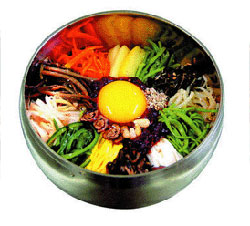
 We were delighted to discover many of the experiences would be hands-on. First up in the kitchen, we donned aprons and started slicing and frying up our julienned carrots, mushrooms etc to assemble our own bibimbaps in the kitchens specially designed for cooking classes. The photo below was taken from another person's blog as the kitchen  and aprons look very similar to the ones we used.


Making a good bibimbap is quite a bit of work. If you're truly fastidious, you'd julienne all the veggies into matchsticks of equal lengths and thicknesses. Next, you'd dutifully stir-fry each kind of veggie with just the right amount of sesame seed oil before assembling them oh-so-slowly, carefully and neatly in the ricebowl before serving it for your guest who will straightaway use the chopsticks to undo your painstaking, tidy arrangements unceremoniously in less than a minute.


Of course, my bibimbap didn't look as neat as the one above but I was  so eager to sample my creation, I forgot to take a pic. Later on, we were escorted into a spacious dining hall called Hanbyeongnu where an impressive banquet was waiting for us - it wasn't really hanjeongsik ( royal banquet) but you could've fooled me with the sizeable number of side dishes ( banchan) that we struggled to empty.


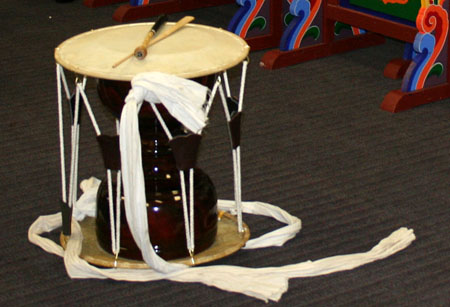
Next, we sat down for a short drumming class, using drums like the one below:


Imagine a bunch of tourists of different generations, from the five year old child to the seventy-plus grandma, all banging away in partial unison. Imagine, I mean, the sight and the sound. Not exactly a standard for Carnegie Hall but we all had great fun.

Later that night, we returned to the Traditional Cultural Centre for a pansori recital. It was in an intimate hall and we sat cross-legged on the floor for a riveting performance. I sat beside a  Korean teenager who was following the singing cum recitation with the entire script/ lyrics in her exercise book. Before we trooped out into the chilly autumn night, we passed by an exhibition displaying craft works using hanji (paper).

So anytime you wish to immerse yourself in an authentic Korean experience to enjoy its cuisine, culture and crafts, look no further than the Jeonju Traditional Cultural Centre near the Jeonju Hanok! HIGHLY RECOMMENDED!

For more on cultural experiences in Jeonju, click here.

sources:
http://english.visitkorea.or.kr/enu/SI/SI_EN_3_6.jsp?cid=799726
http://www.koreanculture.org/bbs/skin/webzang_gallery_trn/show_pic.php?file=data/news/DSC_8759.jpg
http://www.korea.net/cheditor40_asp/cheditor/attach/200792817234622594.jpg
http://oaklandnorth.net/wp-content/uploads/2008/11/drumming31.jpg
http://www.chf.or.kr/chf/eng/facilities/jt/jt.jsp
http://world.kbs.co.kr/english/event/korea_2009/sub01.htm